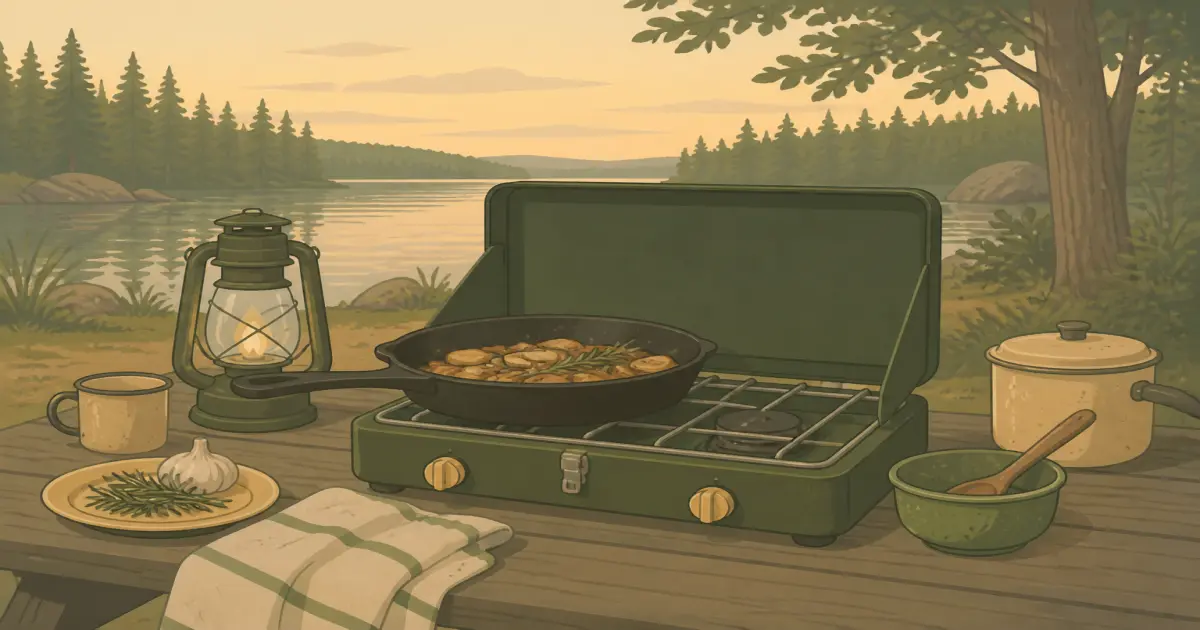
Camping Skillet: When a Pan Beats Another Pot
Cookware
A camping skillet earns space when you fry, sear, or sauté. Match the pan to your stove and cleanup style, then keep a pot for boils and stews.
Our picks
Nesting pots are great until you try to flip an egg up a tall wall. A skillet gives you a wide, flat surface for fry, sear, and sauté. Size it to the stove grate, not to restaurant dreams. A 12-inch pan on a tiny canister burner wastes heat around the edges and tips more easily. See the camp cookware category for pots and kits that pair with a skillet, or start with the best camping cookware guide.
Cast iron holds heat and likes fire, then asks for a dry tote and a light oil film. Nonstick makes eggs easy and dies if you scrape it with a knife. Keep a pot for boils and stews. Pair with cast iron camping cookware, best camping pot set, and aluminum vs titanium camping cookware. Named shortlists live in best camping skillet.
When a skillet beats another pot
Bring a camping skillet when breakfast means eggs or pancakes, when dinner means burgers or quesadillas, or when you want browning that a sauce pot will not give you. Wide surface area matters for evaporation and sear.
Skip a skillet if every meal is boil-in-bag, ramen, or one-pot chili. A lid-tight pot covers that menu with less bulk.
Car campers get the best return. Weight is a trunk problem, not a shoulder problem. Backpackers only bring a small skillet when the menu truly needs it and the pan nests with the rest of the cook kit.
Cast iron, carbon steel, and nonstick
Cast iron holds heat and works on camp stoves and careful fire cooking. It is heavy. It needs drying and a light oil film. It rewards people who already like cast iron at home. Deep care notes live in the cast iron guide linked above.
Carbon steel heats faster than thick iron and still takes a seasoning. It is a middle path for people who want sear without a boat anchor, still with care habits.
Nonstick makes eggs easy and cleanup fast. Keep heat moderate. Use soft utensils. Expect to replace the pan eventually if it lives a hard camp life. Do not preheat empty nonstick on a roaring burner while you unpack the cooler.
Bare aluminum and stainless skillets exist too. Stainless can stick with beginners. Aluminum is light and can hot-spot on small burners. Match metal to your patience and stove.
Size and stove match
Measure your stove grate before you buy a giant skillet. A 12-inch pan on a tiny canister stove wastes heat around the edges and tips more easily. An 8–10 inch pan usually matches weekend couple cooking on a dual-burner or strong single burner.
Folding handles help packing. Fixed handles feel secure and stick out of totes. Either is fine if the handle stays clear of neighboring burners on a two-burner stove. See two burner camping stove for layout.
If you cook for four, two medium pans often beat one huge skillet that never heats evenly outdoors.
Fire vs stove
Stove cooking is controlled and cleaner. Open fire adds soot and hot spots. Cast iron tolerates fire better than most nonstick. Elevate thinking about ash in food and kids near coals.
Use a stable grate. Do not balance a full skillet on sketchy rocks. A picnic table with a dual-burner remains the calm default for most Campsidepicks readers.
Windy sites need a windscreen and patience. Grease pops more when wind blows across the pan. Keep faces back and sleeves clear.
Cooking habits that help at camp
Preheat the pan for a minute, not ten. Add a little oil. Do not crowd burgers or they steam. Have plates ready so food does not sit in a cooling, greasy pan forever.
Keep a lid or foil nearby if ash or light rain threatens. Move the skillet off the burner when you plate so residual heat does not burn the fond you wanted for a quick sauce.
Pair the skillet with a spatula you trust from your camping utensils kit. The pan and the tool are one system.
Cleaning without wrecking the pan
Scrape leftover food while the pan is warm. For cast iron, hot water and a scraper beat long soap soaks. Dry on low heat, then oil lightly. For nonstick, soft sponge only, no steel wool.
Never leave a wet cast-iron camping skillet in a closed tote. Rust blooms fast. Same rule as drying pots after how to clean camping cookware.
Bag sooty exteriors in a separate sack if you used fire. Trunk carpets remember what you dragged home.
Skillet pick, plus a flat-top alternative
Start with the Lodge Pre-Seasoned Cast Iron Skillet 12 Inch when frying is the point of the meal. It handles eggs, smash burgers, and careful fire cooking. Match it to a sturdy dual-burner and accept the weight for car camping. Preheat on medium, not a roaring blast. Scrape while warm, dry hard, oil lightly.
If you cook for four and keep overcrowding one pan, step to the Lodge Double Play Reversible Grill/Griddle across two burners. Same cast iron care, more surface. Measure the grate. A plate that hangs off the ends never heats evenly. For group pancakes, a dedicated camping griddle can beat another round pan.
Common mistakes
Buying a huge iron skillet for a tiny stove is the top miss. Heat the pan you have evenly before chasing steakhouse vibes.
Using metal knives as spatulas on nonstick is how coatings die. Pack the right utensil.
Treating the skillet as a cutting board dulls knives and scars pans. Bring a small camping cutting board. For group breakfasts that need more flat surface than a round pan, see camping griddle.
When to skip a camping skillet
Skip it on boil-only menus and true ultralight trips. Skip novelty electric skillets that need campground power you may not have. Skip a second skillet until the first one is on every trip.
If your gap is nesting pots for coffee water and stews, fix the pot set first. Add the skillet when frying is a real habit.
Sample weekend menu that uses the pan
Friday night: quesadillas or grilled cheese while the dual-burner also heats soup in a pot. Saturday breakfast: eggs and toast. Saturday dinner: smash burgers or fajita veg with a quick sear. Sunday: pancakes if the group still has patience, or a simple scramble before pack-out.
That menu fails in tall pots and works in a camping skillet. If your real weekends look like freeze-dried bags and instant oats, save the money and skip the pan. Honest menus beat gear collections.
For coffee water while the skillet works, keep a camping kettle or a lid-tight pot on the second burner so breakfast does not become a single-file queue.
Bottom line
A camping skillet is the flat pan for eggs, sear, and weeknight-style camp meals. Match material to heat and cleanup, size it to the stove, and dry it before it hits the tote. Keep pots for boils and let the skillet own the fry jobs. For tossed stir-fry nights, see our camping wok guide.
Frequently Asked Questions
Do I need a camping skillet if I have a pot set?
If you only boil and simmer, maybe not. If you fry eggs, smash burgers, or sear fajita meat, a skillet is the right shape.
Cast iron or nonstick for camping?
Cast iron loves fire and high heat and needs seasoning care. Nonstick is easier for eggs and faster cleanup, with lower max heat and a shorter lifespan if abused.
What size camping skillet works for two people?
Often 8–10 inches. Bigger pans need more burner and more storage. Match the pan to the stove grate, not to restaurant dreams.
Can I use a home skillet at camp?
Yes if you accept scratches and soot. Many people keep a dedicated camp pan so home cookware stays prettier.
How do I clean a camping skillet?
Scrape while warm, use minimal soap on seasoned iron, dry fully, and oil lightly if it is cast iron. Nonstick wants soft sponges only.
Is a skillet lid worth packing?
A lid helps simmer and protects from ash on windy tables. Some pots nest as lids. Pack one only if you use it.