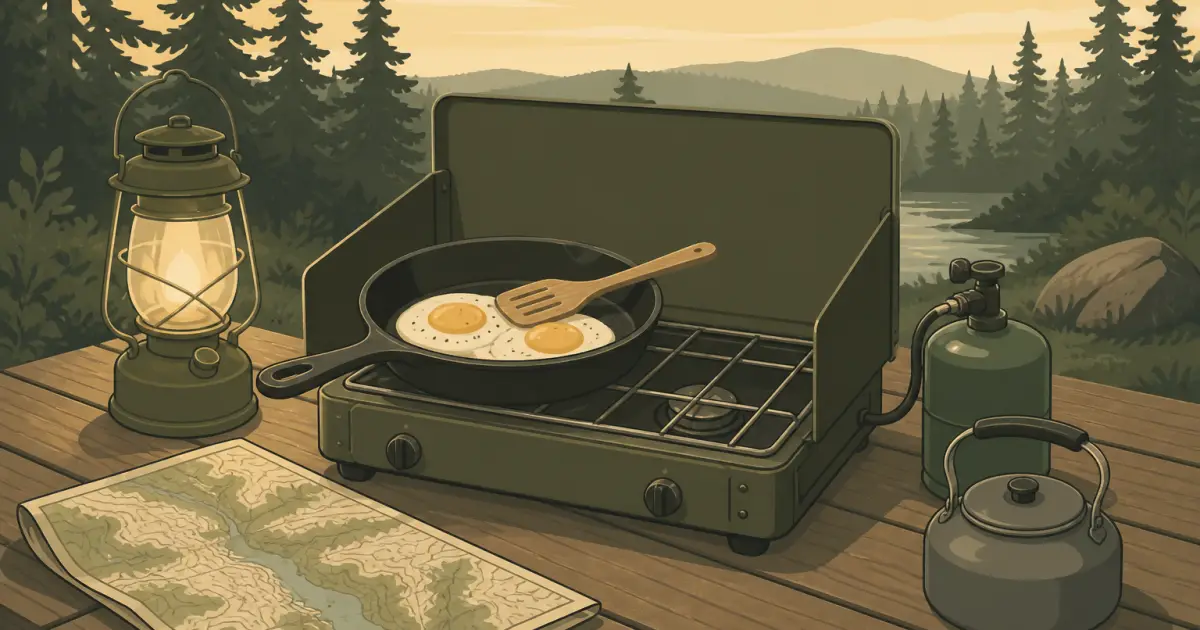
Best Camping Skillet (2026): Cast Iron Pans for Camp Stoves and Fire
Cookware
The best camping skillet matches your burner and your meal plan. These cast iron picks handle car-camp breakfasts, burgers, and campfire cooking.
Our picks
A camping skillet is one of the few heavy pieces of cookware that can earn its place in a car-camp bin. It handles eggs in the morning, burgers at dinner, and a quick sauce when a flat griddle is the wrong shape. The catch is simple: a pan that is too big for your stove cooks unevenly and becomes annoying to pack. See the camp cookware category for the pots and kits that sit beside a good pan, or start with the best camping cookware guide.
Cast iron holds heat when wind hits an outdoor burner. Give it a few minutes on medium before food goes in. Starting on high scorches the center and leaves the edges cool. The material and cleanup habits below cover the rest. For a complete cast iron setup, see cast iron camping cookware.
Size, heat, and grate fit
A good camp skillet sits inside the grate supports instead of hanging over them. Ten inches is the couple default. Twelve inches is for groups with a real two-burner. Ridges suit searing and make cleanup harder. Smooth sides suit eggs and sauces.
Skip lightweight trail fry pans here. They are a different job. Skip home-range monsters that only heat evenly on a kitchen burner. Set the pan on your stove at home before the trip. If the handle clears the neighboring burner there, it will be less stressful at a chilly campsite.
Best overall: Lodge Seasoned Cast Iron Skillet 10.25 Inches
The Lodge Seasoned Cast Iron Skillet 10.25 Inches is the best camping skillet for most people because it is large enough for a real meal but still sensible on a two-burner stove. It can hold eggs and breakfast potatoes, a couple of burgers, or a small batch of fajita vegetables without claiming both burners.
Heat retention is the reason to buy iron. The pan gets easier after a few well-oiled meals. Weight is the complaint, and it is fair. This is a car-camp pan, not a trail pan. Before the first trip, set it on your stove at home. Check that the base sits flat and the handle clears anything on the neighboring burner.
Who it is for: Couples, small families, and campers who want one cast iron pan for breakfast and dinner.
Shop: Lodge Seasoned Cast Iron Skillet 10.25 Inches on Amazon
Before the first trip, set the skillet on your stove at home. Check that the base sits flat on the grate and the handle clears anything on the neighboring burner. If it fits there, it will be much less stressful at a chilly campsite.
Best for a group: Lodge Chef Collection 11 Inch Cast Iron Square Grill Pan
The Lodge Chef Collection 11 Inch Cast Iron Square Grill Pan makes more sense when cooking for three or four people is routine. Wider surface and deeper walls give you room for a full breakfast hash, a bigger batch of vegetables, or four burgers without working in tiny shifts.
Do not buy it for a small canister burner or a narrow grate. A 12-inch skillet needs a stable two-burner stove, a grill, or a solid fire grate. The wider pan needs more heat across its base. A weak burner leaves the edges cool. Pair it with a capable stove from best two burner camping stove, or keep the Lodge 10.25-inch if your setup is compact.
Who it is for: Families and groups that cook full meals at drive-up campsites.
Shop: Lodge Chef Collection 11 Inch Cast Iron Square Grill Pan on Amazon
Best for grill marks: Lodge Square Cast Iron Grill Pan 10.5 Inches
The Lodge Square Cast Iron Grill Pan 10.5 Inches is the specialty choice. Ridges lift food above some pooled grease and leave grill marks on burgers, sausages, and vegetables. It is not the first pan to buy if you mainly cook eggs or simmer sauces.
Cleanup is the trade. Cheese, marinades, and sticky sauces collect between the ridges. Bring a scraper and do not leave the pan until morning. Keep heat moderate at first. A hot ridged pan can scorch food long before the center cooks through if you start on full blast.
Who it is for: Campers who already own a smooth skillet and want a pan for burgers, sausages, and grilled vegetables.
Shop: Lodge Square Cast Iron Grill Pan 10.5 Inches on Amazon
This pan works best on a solid camp stove or a grill with an even grate. Keep heat moderate at first. A hot cast iron grill pan can scorch food long before the center cooks through if you start with the burner on full.
Lodge Pre-Seasoned Cast Iron Skillet 12 Inch
The Lodge Pre-Seasoned Cast Iron Skillet 12 Inch is the larger smooth pan for a family or a group with a real two-burner stove. It handles eggs, smash burgers, and careful fire cooking. At about 8 lb it moves easily and the assist handle makes a loaded pan manageable, but it wants a stable grate and will overhang a tiny canister burner.
Match it to a sturdy dual-burner and accept the weight for car camping. Preheat on medium, not a roaring blast. Dry it hard after washing and wipe a thin coat of oil so rust does not start in the tote.
Who it is for: Camp cooks who feed three or four people and want one wide smooth pan.
Shop: Lodge 12-Inch Skillet on Amazon
Lodge Double Play Reversible Grill/Griddle
The Lodge Double Play Reversible Grill/Griddle gives you a flat top and a ribbed grill face in one cast-iron plate that spans two burners. It is the upgrade when one round skillet keeps overcrowding at breakfast. One side is flat for eggs and pancakes, and you flip it for a ribbed grill.
It weighs roughly nine pounds and needs two solid burners and dry storage. Measure the grate. A plate that overhangs wildly wastes fuel and warps heat. Preheated cast iron browns well and holds heat through wind.
Who it is for: Campers who already own a dual-burner stove and want more flat surface without a second tank system.
Shop: Lodge Double Play on Amazon
Choose the skillet size before you buy
For two people, a 10 to 10.25-inch smooth skillet is the easy answer. It has enough space for breakfast and dinner but does not overwhelm a camp table. It also leaves room for a pot or kettle on the second burner.
For three or four people, a 12-inch skillet avoids cooking in too many batches. It earns its extra weight when you use a full-size stove and cook at the campsite often. If the group only eats oatmeal and boil-in-bag dinners, leave the iron at home and spend the space on a better pot set.
Skillet diameter is only half the question. Check the bottom of the pan against your stove grate. A large skillet on a narrow grate is a tipping risk, especially once it is full of hot food.
Cast iron on a camp stove and fire
Cast iron holds heat well, which helps when wind hits an outdoor burner. Give it a few minutes over medium heat before adding food. Starting on high is the fastest route to a scorched center and cool edges.
On a camp stove, keep the pan centered and turn the handle away from the aisle of the picnic table. Do not put a heavy 12-inch skillet on a tiny backpacking burner. The pan can feel unstable and the small flame will not heat it evenly.
On a fire, use a stable grate and work over a bed of coals rather than tall flames. Fire leaves soot on the bottom of any pan, so pack the skillet in a towel or dedicated bag for the drive home. Read our camping stove setup guide before the trip if you need a safer table and fuel routine.
Cast iron, carbon steel, and nonstick
Cast iron holds heat and works on camp stoves and careful fire cooking. It is heavy. It needs drying and a light oil film. It rewards people who already like cast iron at home.
Carbon steel heats faster than thick iron and still takes a seasoning. It is a middle path for people who want sear without a boat anchor, still with care habits.
Nonstick makes eggs easy and cleanup fast. Keep heat moderate. Use soft utensils. Expect to replace the pan eventually if it lives a hard camp life. Do not preheat empty nonstick on a roaring burner while you unpack the cooler.
Bare aluminum and stainless skillets exist too. Stainless can stick with beginners. Aluminum is light and can hot-spot on small burners. Match the metal to your patience and stove.
Fire or stove
Stove cooking is controlled and cleaner. Open fire adds soot and hot spots. Cast iron tolerates fire better than most nonstick. Use a stable grate and do not balance a full skillet on sketchy rocks. A picnic table with a dual-burner remains the calm default for most camp cooks.
Windy sites need a windscreen and patience. Grease pops more when wind blows across the pan. Keep faces back and sleeves clear.
Sample weekend menu that uses the pan
Friday night: quesadillas or grilled cheese while the dual-burner also heats soup in a pot. Saturday breakfast: eggs and toast. Saturday dinner: smash burgers or fajita veg with a quick sear. Sunday: pancakes if the group still has patience, or a simple scramble before pack-out.
That menu fails in tall pots and works in a camping skillet. If your real weekends look like freeze-dried bags and instant oats, save the money and skip the pan.
How to clean and pack a camping skillet
Clean the pan while it is still warm enough for food to release. Scrape it, add a little hot water if needed, and wipe it dry. A brief warm-up on low heat gets rid of the last moisture. Then use a paper towel to apply a very thin film of oil.
Do not soak cast iron in a wash bin overnight. Do not pack it wet in a sealed tote. Both habits make rust far more likely than using a little soap when dinner gets messy. Our how to clean camping cookware guide has the full routine.
Wrap the skillet in a towel or slide it into a cloth sleeve. That protects the seasoning and keeps soot or cooking oil off the rest of your kitchen gear. Put the handle where it cannot punch into a soft cooler bag on a bumpy road.
Common camping skillet mistakes
Buying the largest pan because it looks versatile. A 12-inch pan is great for groups, but a 10-inch pan cooks more evenly on many camp stoves and gets used more often.
Using high heat for every meal. Cast iron stores heat. Medium heat and a short preheat work better for eggs, vegetables, and most burgers.
Packing it wet. Drying takes two minutes. Dealing with rust at the next trip takes longer and is less fun.
Treating a grill pan like a smooth skillet. Ridged pans are fine for burgers and vegetables. Eggs and sauce-heavy meals are easier in a smooth skillet.
Putting iron on an unstable surface. A hot, loaded skillet needs a real table, grate, or stove. Do not balance it on rocks, a cooler lid, or a crooked folding tray.
Bottom line
The Lodge Seasoned Cast Iron Skillet 10.25 Inches is the best camping skillet for most car campers because it balances usable cooking area with a manageable size. Buy the Lodge Chef Collection 11 Inch Cast Iron Square Grill Pan if group meals are your normal routine. Add the Lodge Square Cast Iron Grill Pan 10.5 Inches only when grill-style meals are a regular part of the plan.
Match the pan to your stove, dry it before it goes in the tote, and keep a smaller camping griddle or pot setup for the jobs a skillet does not handle well.
Frequently Asked Questions
What size camping skillet is best for two people?
A 10 to 10.25-inch skillet is usually the sweet spot. It holds eggs, sausage, or two burgers without overhanging a typical camp-stove grate.
Is cast iron good for camping?
Yes for car camping, cabin trips, and short walks from the car. It handles high heat and lasts for years, but it is too heavy for most backpacking trips.
Can I use a cast iron skillet on a camping stove?
Yes, if the grate supports the pan evenly and the skillet is centered over the burners. Avoid a large pan on a tiny backpacking stove because the base can feel unstable.
Should I bring a 10-inch or 12-inch skillet camping?
Choose 10 inches for two people and easier packing. Choose 12 inches when you cook for three or four people and have a full-size two-burner stove.
How do I clean a camping skillet?
Scrape it while warm, wash with a little water if needed, then dry it fully. Heat it briefly on low and wipe on a very thin layer of oil before packing.
Do I need a skillet if I have a camping griddle?
Not always. A griddle is better for pancakes and a crowd. A skillet is more useful for sauces, sautéed vegetables, and meals that need taller sides.
Cast iron or nonstick for camping?
Cast iron loves fire and high heat and needs seasoning care. Nonstick is easier for eggs and faster cleanup, with lower max heat and a shorter lifespan if abused.
Can I use a home skillet at camp?
Yes if you accept scratches and soot. Many people keep a dedicated camp pan so home cookware stays prettier.