Best Camping Pot Set (2026): Nested Cookware That Earns Space
Cookware
A camping pot set, or a camping pot and pan set, should nest tightly, cover your real menu, and skip filler pieces you will never heat.
Our picks
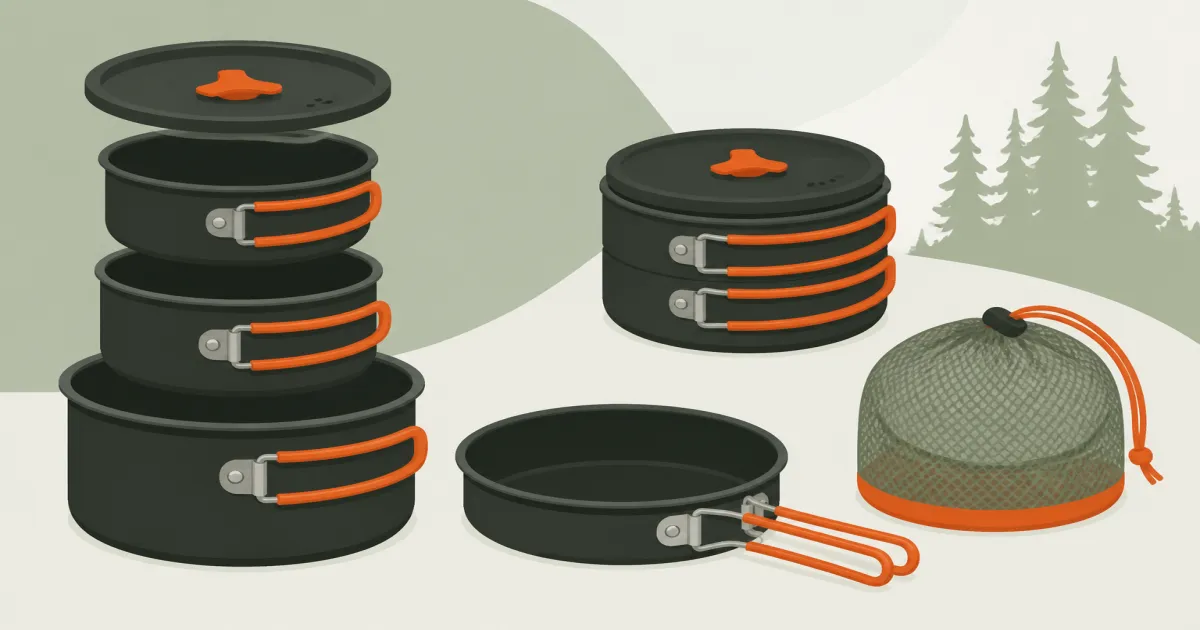
A camping pot and pan set fails when it is a tower of plates you never heat, or a toy cup that cannot boil pasta. You want pots that nest, lids that actually fit, and a fry surface if eggs are on the menu. Car camping can carry stainless. Trail miles want something lighter from best backpacking cookware. The camp cookware category collects the rest of the nests, skillets, and prep tools, and the best camping cookware guide frames the whole set.
Packed size is the first honest test. If it does not close into one cylinder or bag, it will rattle into a junk drawer. Pot volume is the second: roughly 1.5 to 2.5 L for the main pot covers two adults, a stock-pot class for families. Stainless sticks more than nonstick and lasts longer in a trunk. Match the base to your stove so a wide pot does not teeter on a tiny canister burner.
Comparison table
Top pick: GSI Bugaboo Camper Cookset
The GSI Outdoors Bugaboo Camper Cookset is the best camping pot set for car-camp couples and small families who cook real meals. You get a 3L pot, a 2L pot, two crushproof strainer lids, a 9-inch ceramic frypan, four mugs with insulated sleeves, four bowls, four plates, a folding pot gripper, and a welded stuff sack that doubles as a sink.
The ceramic nonstick coating is why cleanup is quick: eggs and sticky sauces release with a wipe instead of a soak. The gripper locks onto brackets on the pots and pan, so you lift hot cookware without scraping the coating or juggling a towel. Color-coded mugs, bowls, and plates mean everyone keeps their own, which cuts dish confusion at a four-person table.
On a dual-burner, the 3L and 2L pots run pasta and sauce at the same time. Keep the frypan for eggs and quesadillas rather than high-heat searing, and use nylon or silicone tools so the coating lasts. This is car-camp and short-hike cookware, not a thru-hike gram kit.
Who it is for: Couples and small families who cook real meals at the picnic table, and anyone replacing a chaotic pile of mismatched pots.
Who should skip it: Chili-for-six nights, high-heat searing, and boil-only pouch hikers. Trail ounces want titanium from the backpacking guide.
Pros
- Complete four-person set nests into one bag
- Ceramic nonstick coating wipes clean fast
- Crushproof strainer lids drain pasta and rice without a colander
- Folding gripper locks onto pot brackets without scratching
- Carry sack doubles as a camp sink
Cons
- Heavier than compact backpacking kits
- Ceramic coating needs nylon or silicone utensils
- Lid is not meant for frying or hot oil
Shop: GSI Bugaboo Camper Cookset on Amazon
Best value: Stanley Wildfare Core 26-Piece
The Stanley Wildfare Core 26-Piece Complete Camp Kitchen Cook Set earns its bulk when dinner is pasta plus sauce plus eggs in the morning. You get a 4 qt pot with lid, an 8-inch stainless frypan, and four place settings with plates, bowls, and utensils, all BPA-free.
The nesting design is the value here: the pot, pan, and tableware stack into one compact bundle if you pack it in order. It is heavy. That is fine when the car carries it. Wash duty grows with the piece count, so do not buy this for freeze-dried weekends.
It sits well on a Coleman-style dual-burner. A tiny canister head under the 4 qt pot wastes fuel and feels tippy. If the set includes dishes you will not use, leave them home and keep the pots.
Who it is for: Families, friend groups, and car campers who cook mains and sides together.
Pros
- Real multi-course capacity
- Dedicated frypan and full tableware for four
- Clever nesting keeps the kitchen compact
- Stainless durability for years of car camping
Cons
- Heavier to load and unload
- More dishes to wash
- Overkill for boil-only campers
Shop: Stanley Wildfare Core 26-Piece on Amazon
Best budget: Stanley Wildfare Go 14-Piece
The Stanley Wildfare Go 14-Piece Stainless Steel Prep & Cook Set is the compact kit for simple menus. It nests a 1.65 qt saucepan with a fold-and-lock handle, a vented lid with strainer holes, two bowls, utensils, and a cutting board into one small bundle.
You cannot run two pans. You will outgrow it for group chili. Cleanup is easy because the pieces stack and wipe down. Buy it when you hate overbuying, not when you want a picnic-table kitchen.
Who it is for: Campers who cook one-pot meals and hate extra pieces.
Pros
- Low cost and low clutter
- Compact nesting system
- 18/8 stainless is induction compatible and dishwasher safe
- Folding handle saves pack space
Cons
- One saucepan only; no dedicated frypan
- Limited simultaneous cooking
- May outgrow it for big groups
Shop: Stanley Wildfare Go 14-Piece on Amazon
Sizing guide (quick)
Volume markings inside pots help with dehydrations and grain ratios. Not required, but handy.
Materials without the mystique
Stainless: Tough and repair-friendly in the sense that scratches are cosmetic. Great for higher heat if you cook carefully. The Stanley Wildfare sets play here; the GSI Bugaboo Camper uses a ceramic nonstick coating instead, which cleans up faster but needs gentler tools.
Hard-anodized aluminum: Strong everyday choice for camping pot sets. Heats quickly. Watch coating care if nonstick.
Titanium: Usually a backpacking play. Overkill for many car-camp pot sets unless you also hike with the kit.
Match material to abuse level. Kids flipping utensils in a nonstick pan is a coating death sentence.
Pot sets and stoves
Wide pots on tiny backpacking burners are unstable. Small pots on huge dual-burner grates can tip if supports are sparse. Before you buy, picture the set on the stove you own from our stove guide. Heat control matters as much as metal type.
Common buying mistakes
Chasing piece count. Eight unused cups are not value.
Ignoring lids. A pot without a lid wastes fuel and time.
Buying trail kits for trunk kitchens (and the reverse). Use the backpacking guide when ounces rule. Use this page when nesting and meal capacity rule.
Forgetting cleanup water. Greasy pans need a plan. Bring a scraper and a small amount of camp-safe soap.
Skipping a stuff sack. Nesting only helps if parts stay together in the bin.
First trip meal plan (simple)
Night one: boil pasta in the main pot with lid on for fuel savings. Night two: reheat chili or stew in the same pot while coffee water heats in the smaller vessel. Breakfast: use the fry pan or lid-pan if your set includes one. That three-meal plan tells you whether you bought too much or too little before you reorder.
Bottom line
The best camping pot set matches menu and stove size, not the highest piece count on the box. Buy the GSI Bugaboo Camper for couples and small families, the Stanley Wildfare Core 26-Piece for family meals, or the Stanley Wildfare Go 14-Piece for simple boil-focused trips. Fewer better pieces beat a rattling tower you never fully unpack.
Frequently Asked Questions
How many pots do I actually need?
Most weekend trips need one medium pot and one smaller pot or kettle. The GSI Bugaboo Camper covers couples and small groups well. Lids matter more than collecting extra empty vessels.
Should a pot set include a frying pan?
Helpful for eggs and quesadillas on car trips. The Stanley Wildfare Core 26-Piece includes a dedicated pan. Skip a pan for boil-only menus.
Nonstick or stainless pot sets?
Nonstick wins for easy cleanup and sticky foods. The GSI Bugaboo Camper leans nonstick with its ceramic coating. Stainless like the Stanley Wildfare Core wins for longevity and higher-heat searing if you manage food stick with oil and technique.
Are 10-piece sets worth it?
Sometimes for families who will use plates and mugs in the set. Often no for couples. Count the pieces you will heat, not the pieces in the marketing photo.
Can one pot set do backpacking and car camping?
A light nested duo can moonlight for both if you accept compromises. Dedicated trail kits still win for serious mileage. See the backpacking cookware guide for ounce-first picks.
What size for two adults?
Roughly 1.5–2.5 L for the main pot covers pasta and stews. The GSI Bugaboo Camper 2L pot and the Stanley Wildfare Core 26-Piece both land in useful ranges for two to four people depending on menu.
What is the difference between a camping pot set and a camping pot and pan set?
A pot set may be boil-first: pots, lids, maybe a mug. A camping pot and pan set adds a fry surface for eggs and quesadillas. The Stanley Wildfare Core 26-Piece is the pan-included pick here. The Wildfare Go is not.
Is the GSI Bugaboo Camper Cookset big enough for a family of four?
For most pasta nights, yes. The 3L pot handles a full box of pasta, and the 2L pot runs sauce or vegetables at the same time on a dual-burner. For chili or stew nights, expect to cook in two batches.