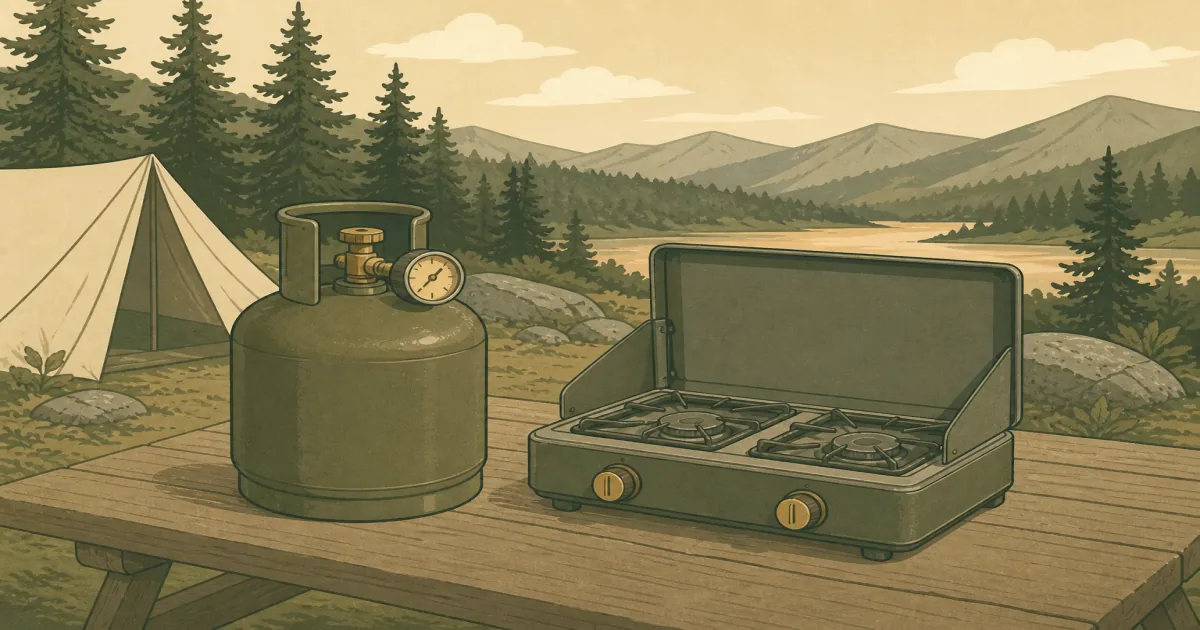
Propane Tank Gauge for Camping: Know Before Dinner Dies
Stoves
A propane tank gauge tells you whether the bulk tank still has dinner in it. Screw it onto a Type-1 tank valve, read the color or dial, and stop guessing.
Our picks
Nothing ruins a campsite mood like a stove that fades while pasta is still hard. With bulk propane, the tank looks the same full or nearly empty. A propane tank gauge gives you a quick read so you can swap tanks before the sauce burns. Fuel monitoring gear sits in the stoves category, and the best camping stove roundup covers the burners it feeds.
This is a car-camp accessory. It belongs with hose adapters, trees, and two-burner ranges. It does not belong in a ultralight pack next to a 4-ounce canister. If your whole fuel plan is disposable 1 lb bottles, count spares instead of buying a gauge.
When a propane tank gauge earns space
Buy one when you already run a 5 to 20 lb tank for a two-burner camping stove, a propane camping lantern, or a camping propane tree. Long weekends, group sites, and cold mornings empty tanks faster than people expect.
Skip it when you only light a small stove for coffee and always bring two fresh 1 lb bottles. The gauge cannot invent fuel. It only reports what is left on a compatible bulk tank.
How to use it without drama
- Confirm your tank uses a Type-1 (QCC) valve. That is the common BBQ-tank connection.
- Thread the gauge on hand-tight, then snug as the maker directs. Do not force cross-threads.
- Open the tank valve slowly and watch for hissing that is not a normal short purge.
- Read the color bands or dial with the tank upright on flat ground.
- Recheck after the car ride. Vibration loosens soft seals.
A gauge is a planning tool. It will not make a half-empty tank last a scout troop dinner. If the read is low before you start cooking, swap tanks while everyone is still calm.
What to pack with it
Keep the gauge with your fuel kit, not buried under cookware. Useful neighbors:
- A known-good hose or propane adapter for camp stove setup
- A spare bulk tank for long trips
- Soap solution or a spray bottle for leak checks on new joints
- A notepad or phone note with “tank swapped Saturday”
For the stove side of the routine, camping stove setup and camp stove fuel types keep fuel choices honest.
Gauge vs weighing vs spare bottles
Some people weigh a tank at home and write the empty weight on tape. That works. It is also easy to forget after a long drive. A propane tank gauge is faster at the picnic table when dinner is already started.
Spare 1 lb bottles are still the right plan for tiny stove kits. They are the wrong plan for a family two-burner and a lantern on bulk propane. Match the measuring tool to the fuel system you actually run.
If you split one tank across a stove and lantern, read the gauge before you light the second appliance. A low tank that still boils water may fail when you add a lantern draw.
Kit picks for the tote
The Flame King Propane Tank Gauge Level Indicator Leak Detector is the gauge most car campers should start with. Color coding is easy to glance at in daylight. The glow-in-the-dark face helps when dinner prep runs into evening. It is built around common Type-1 tank valves in the 5 to 40 lb range, which matches how most campsites run bulk propane.
The simple Propane Tank Gauge Level Indicator Leak Detector for BBQ Gas Grill Type 1 is a sensible spare. If you haul two tanks, put a gauge on the backup before you leave the driveway. That beats discovering both tanks are sad after dark.
Neither gauge turns a disposable bottle into a smart cylinder. Match the tool to bulk tanks.
Camp routine that actually sticks
Before you leave home, confirm the gauge threads match the tank you are taking. At the site, connect the gauge, open the valve, and glance at the read before you unpack the cooler. Mid-weekend, check again before a long dinner. Before you drive home, close the tank valve and bag the gauge so grit does not pack into the threads.
Teach everyone cooking that “red means swap now.” Do not wait for the burner to whisper. That is how pasta water never returns to a boil and tempers get short.
Common mistakes
Expecting precision to the ounce. These are level indicators, not lab meters. Treat green as “cook,” yellow as “plan,” and red as “swap.”
Using it on the wrong valve. Tiny disposable bottles and some specialty fittings will not match.
Skipping the leak check. New metal-on-metal joints deserve a soap check the first time you assemble them.
Reading a tank on its side. Keep tanks upright unless the maker says otherwise.
Ignoring cold weather. Pressure and apparent readings can look different in cold mornings. Give the system a moment after opening the valve.
Buying a gauge and never packing a spare tank. A gauge reports emptiness. It does not refill the cylinder.
Bottom line
A propane tank gauge is cheap insurance for bulk-propane car camps. Pack the Flame King gauge on the tank you cook from, and keep a simple Type-1 spare if you run two tanks. Pair it with a sane hose layout, and dinner stops being a fuel surprise.
Frequently Asked Questions
What does a propane tank gauge do at camp?
It screws onto a Type-1 tank valve and gives a rough fuel-level or pressure-style read so you are less likely to lose flame mid-dinner.
Will it work on 1 lb disposable bottles?
Usually no. Most camping propane tank gauges are built for bulk BBQ-style Type-1 tanks, not the little green bottles.
Is a gauge better than lifting the tank?
Lifting still works as a rough check. A gauge is faster and cleaner when the tank is hooked into a hose tree or stove line.
Can I leave the gauge on all weekend?
Many people do for the trip. Recheck connections after travel bumps, and store fittings where dirt cannot pack into the threads.
Does a propane tank gauge replace a leak check?
No. Soap-bubble leak checks on new connections still matter. A gauge helps with fuel level; it does not excuse sloppy fittings.
Should I buy a gauge if I only use 1 lb bottles?
Probably not. Track spare bottles instead. A gauge pays off when you run bulk tanks for a stove, lantern, or propane tree.
Where does this fit with a propane tree?
After the tank valve and before or within your hose layout, depending on the parts. See camping propane tree for distribution setups.