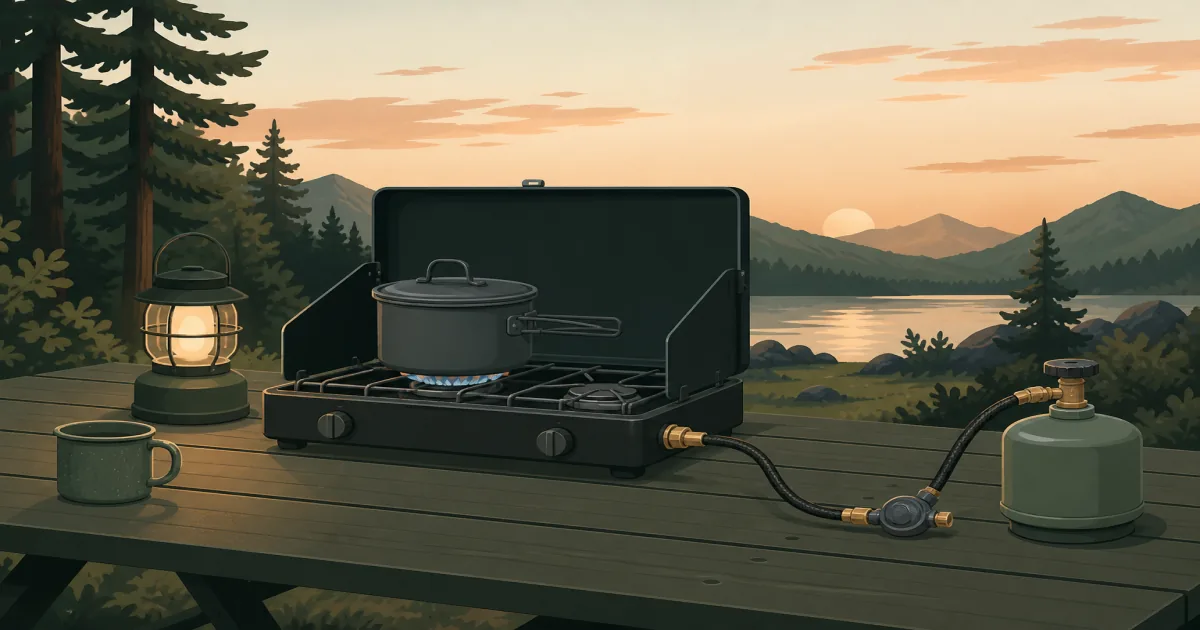
Propane Adapter for Camp Stove: Which Hose Fits and What to Skip
Stoves
A propane adapter for camp stove use should match your stove valve, tank thread, and trip style. The right hose adds reach and runtime. The wrong one adds leaks and frustration.
Our picks
Most adapter mistakes happen before the stove lights. People buy a hose because the product photo says "camping" and then discover the threads do not match, the regulator path is wrong, or the tank has to sit awkwardly under the table. A propane adapter for camp stove use should solve one practical problem: turning a short-runtime bottle setup into a longer, calmer kitchen layout. Hose and fuel gear lives in the stoves category, with the best camping stove guide for the burner end.
If you are still figuring out fuel families, read camp stove fuel types first. If your question is whether propane or butane makes more sense, start with propane vs butane camping stove. This guide is narrower. It is about the hose and fitting side of propane, not a general fuel debate.
When does a propane adapter make sense?
The classic case is a two-burner table stove that normally drinks 1 lb bottles. Those bottles are easy for short trips, but they run dry fast on family weekends. A hose lets you pull fuel from a larger tank while the stove stays on the picnic table.
One 20 lb tank carries about 430,000 BTU. A 1 lb bottle carries about 21,600 BTU. That is about twenty times the fuel, held in one refillable container instead of a stack of disposables. It also lets the tank sit on the ground or beside the table, where it is less likely to get bumped.
You do not need an adapter for every trip. If you only make coffee and one simple dinner, the plain 1 lb bottle may be easier. The hose is the calmer choice when you cook more than one meal a day, stay out several nights, or hate discovering an empty bottle halfway through breakfast. Add a propane tank gauge so the bulk tank does not run dry mid-dinner.
Which fitting goes on which end?
The tank end is a QCC1 / Type-1 fitting, the wide nut that threads onto most 5 to 40 lb tanks. Older tanks use a POL fitting. The appliance end is the 1 inch by 20 male throwaway thread, the same thread as a small 1 lb bottle, so the hose screws in where the bottle used to sit.
Match the tank fitting first, then the appliance thread. If the manual does not support a bulk tank hookup, skip the shortcut. This guide pairs closely with camping stove setup, which covers the connection and the leak check.
How long does a 20 lb tank last on a camp stove?
At a two-burner stove's output of about 22,000 BTU per hour, a 20 lb tank runs about 19.5 hours and a 1 lb bottle about an hour. That is the real reason to carry the tank: a weekend of meals on one fill.
The tank is better in every column except portability. It is heavy when full, near 37 lb, so it lives in the vehicle and feeds the stove through the hose. A 1 lb bottle stays the right answer for a solo overnighter where the stove never leaves the pack.
Top pick: 6 Feet Propane Hose Adapter 1lb to 20lb Converter
The 6 Feet Propane Hose Adapter 1lb to 20lb Converter is the better propane adapter for camp stove setups that run a full weekend kitchen. Six feet is enough length to move the tank off the table zone and still keep the stove comfortable to use.
That matters more than people think. A hose with enough reach makes the whole setup calmer. The tank can stay low and out of the way. You are not twisting the stove to gain an extra inch. You are not pinning the fuel line under a table leg.
This is the pick for family sites, group breakfast duty, or any stove that stays out for repeated meals. It is a little more to store afterward, but the extra length is the reason it takes the top slot.
What the six-foot hose changes
Reach is the whole feature. With six feet, the tank sits about three steps from the burner, which keeps the hot stove and the fuel separate and leaves the table for plates. Route the hose so it never crosses under a burner or lies in a footpath. Keep the tank upright and lower than the stove, and the fuel feeds by pressure with no lifting.
Best compact value: GasSaf 4FT Propane Hose
The GasSaf 4FT Propane Hose is the cleaner choice when your table layout is already simple. Four feet is enough for many one-stove picnic table setups, and it is easier to coil into a tote than a longer line.
The connections are solid brass, so they seal tight and resist corrosion, and the hose itself is multi-layer rubber with a nylon mesh core for high pressure. If your stove lives on a folding camp table with the tank directly beneath or beside one leg, this shorter hose often feels neater.
For many weekend campers, that is fine. Not every setup needs maximum reach. It just needs enough reach to keep the propane bottle out of the stove's hot zone.
Why the four-foot hose packs smaller
Two fewer feet is about 50 percent less hose to wrap. On a tight table, that is the difference between a line you tuck behind a leg and a line you trip over. If the tank cannot sit within four feet of the burner, step up to the six-foot hose instead of stretching this one across open ground.
Do you need a regulator with the hose?
No, as long as your appliance already has one. This class of 1 lb to 20 lb adapter hose carries no regulator of its own. It feeds the regulator built into the stove, lantern, or heater, which then sets the working pressure at the burner.
That is why the same hose works on a Coleman-style camp stove and fails on a plain griddle. Camp stoves ship with a regulator; many griddles and grills assume the hose includes one. If yours has no regulator, buy a hose with a regulator built in, or the flame will not hold a steady setting.
The stove that already has a regulator
A two-burner table stove keeps its regulator between the fuel inlet and the burners, so the 1 lb thread accepts the hose directly. Check the manual for the phrase "bulk tank" or "20 lb" before you buy. If it is not there, the stove may be built for disposable bottles only.
How to leak test the connection
Open the tank valve with the burner off, then brush soapy water on both hose ends. Bubbles mean a loose fitting, a bad gasket, or a cracked hose. Tighten by hand and retest. The whole check takes under a minute and catches the small leaks that turn into a surprise at the burner.
Can you convert a butane stove to propane?
Usually no. A cassette butane stove uses a different canister latch and its own gas path, and most have no 1 lb thread for a propane hose to grip. A few dual-fuel or conversion models accept a propane adapter, but that is a specific design, not a universal swap. Keep butane in the butane lane unless the manual names a propane conversion.
What people get wrong with propane adapters
The biggest mistake is treating every propane hose like a universal fix. It is not. A propane adapter for camp stove use only works when the connection style matches the stove and the regulator path makes sense.
The next mistake is poor tank placement. A good hose does not help if the tank sits where someone kicks it, where the hose crosses the cook path, or where hot grease can drip onto it. Keep the line clear, keep the tank upright, and keep the route simple.
The third mistake is skipping the regulator check. If the appliance has no regulator of its own, the hose has to supply one. A hose without that part will not control the flame, no matter how good the brass looks.
The fourth mistake is choosing by price alone. Cheap hoses are fine when they fit and seal well. Cheap mystery hardware with vague photos is not worth saving ten bucks if it ruins dinner or makes you distrust the whole setup.
Should you convert at all?
If you camp a few times a year, maybe not. Disposable bottles are simple and widely available in the US. For short trips, that convenience can beat the extra gear.
If you camp often, cook for a group, or already keep a refillable tank at home, an adapter starts to make sense fast. The fuel math improves, and the setup gets less annoying on longer weekends.
That is especially true if your main stove already lives in the car-camp lane. See best-two-burner-camping-stove if you are still deciding whether your kitchen is really a table-stove setup or a smaller single-burner system.
Bottom line
The best propane adapter for camp stove use is the one that matches your stove's fitting, feeds a stove that has its own regulator, and gives the tank a safe place to sit. Buy the 6 Feet Propane Hose Adapter 1lb to 20lb Converter when reach is the main problem. Buy the GasSaf 4FT Propane Hose when your layout is tight and you want less bulk. Then set the tank low, route the hose cleanly, and let the 20 lb tank carry about nineteen hours of cooking instead of one.
Frequently Asked Questions
What does a propane adapter for camp stove use actually do?
It lets a stove that normally runs from a small disposable 1 lb propane bottle draw fuel from a larger 20 lb tank through the correct hose and fitting.
Does the adapter hose include a regulator?
Usually not. The hose feeds the regulator your stove already has. A griddle or grill with no regulator needs a hose that includes one, or the flame will not hold a steady setting.
How long does a 20 lb tank last on a camp stove?
A 20 lb tank holds about 430,000 BTU, and a two-burner stove burns about 22,000 BTU an hour, so roughly 19.5 hours of cooking. A 1 lb bottle holds about 21,600 BTU, about one hour.
Can I use any propane hose on any camp stove?
No. Thread type, regulator setup, and the stove's intended fuel path still have to match. Start with the stove manual, not the product photo.
Is a longer hose always better?
Not always. Longer hoses make tank placement easier, but they add bulk and can create more clutter on a small picnic table setup.
Do I need an adapter for butane stoves too?
Only some dual-fuel or conversion setups. A cassette butane stove is not the same job as a 1 lb propane bottle hookup.
Will a bulk tank save money?
Usually yes if you camp often. A refillable tank often costs less per weekend than burning through several 1 lb bottles.
How do I know the hose is too close to the heat?
If the hose touches hot metal, crosses under the burner, or crowds the flame path, reroute the whole setup before you cook.