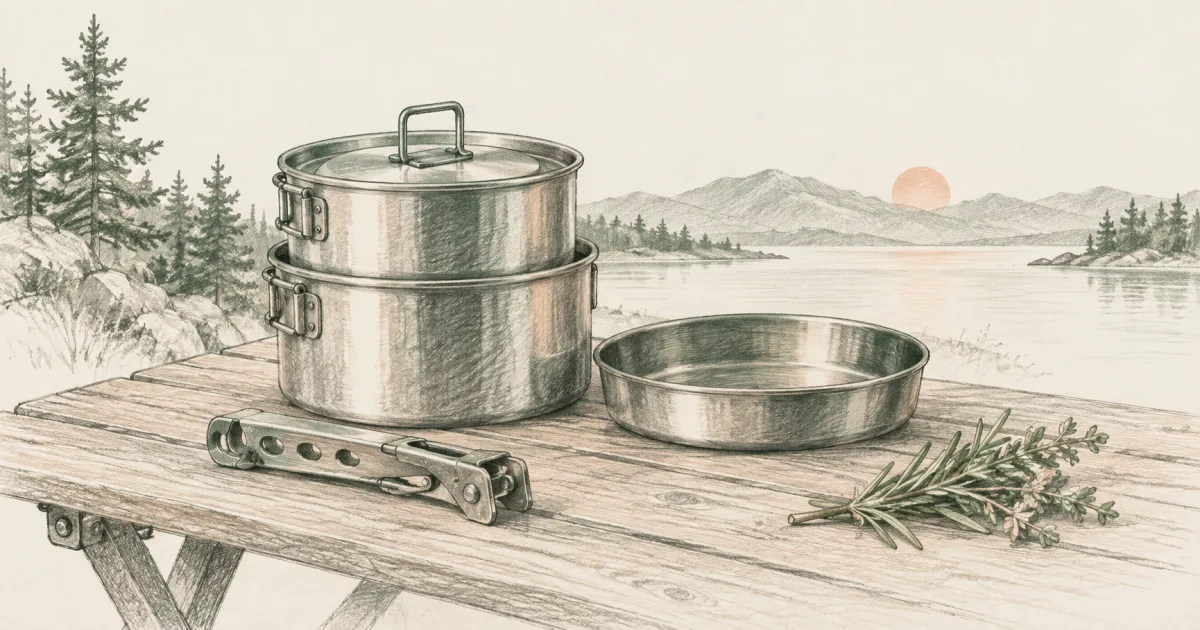
Stainless Steel Camping Cookware Set (2026): 2 Sets Worth Buying
Cookware
A stainless steel camping cookware set is the one camp kitchen purchase that outlasts the trips you bought it for. Here are the two sets worth packing, what each one costs per piece, and how much shelf space the whole kit really takes.
Our picks
A stainless steel camping cookware set is the camp kitchen purchase you make once. Unlike a scratched nonstick kit, stainless takes high heat, shrugs off being stacked in a tote, and cleans back to bare metal with a little soaking. The Magma 10-Piece is the set to buy if you cook at camp the way you cook at home, because its triple-clad bases behave like kitchen pans.
The catch is weight. Stainless is heavier than aluminum, so these sets live in the car, not the pack. If you carry your kitchen on your back, the cookware category has lighter options, and our best camping cookware pillar covers the nesting kits that compete with these. For the metal question itself, see aluminum vs titanium camping cookware.
Two numbers decide which set is right. Piece count sets what you can cook at once, and packed volume sets whether the kit actually lives in the truck. A couple who boils water and fries eggs needs far less than a family of five cooking two pots at a time.
What makes a stainless camp set worth it
Look for a triple-clad or double-bottom base. A thin stainless pot develops a hot ring in the center and scorches oatmeal. An aluminum core sandwiched between stainless spreads heat across the whole base, which is why the better camp sets cook like home pots.
Look for nesting with a real packed size. A set that stacks into one pot or bag takes a quarter of the space of loose cookware and does not rattle down the road. Detachable or folding handles are the other half of that trick, and they are also what lets a pot go flat in a drawer.
Look for metal you can abuse. Stainless pots handle metal spoons, a scrub pad, and a hot campfire grate. Keep one nonstick pan for eggs if you like easy breakfast cleanup, but do not expect a coating to last seasons of camp use.
What does triple-clad actually mean?
Three bonded layers: stainless on the inside, an aluminum core, and stainless on the outside that a magnet can grab. The aluminum does the heat spreading, which is why a triple-clad pot browns at the rim instead of scorching a ring in the middle.
A single-layer pot is one sheet of steel, so heat travels slowly and unevenly. A double-bottom pot has the core only in the base, which is enough for a camp stove but not for oven heat coming from every side. If a listing does not say clad or double-bottom, assume neither.
Does a nested set rattle while you drive?
Only if the pieces are loose in the box. A proper nesting kit stacks into one unit with a bungee, strap, or tote, and stays quiet on a fire road. If yours clatters, a set of felt pot protectors or a dish towel between the pans fixes it for a few dollars.
The Magma set closes with a bungee, and owners on the Airstream forum use the brand's pot protectors between pans to keep the stack quiet and unmarked. That is a small purchase worth making on day one.
Which set should you buy?
The Magma is the set you buy once. It is heavier, it costs four times as much, and it is the only one here that behaves like kitchen cookware on a camp stove. The KingCamp is the set you buy when four people need to eat and the tote is already full.
Top pick: Magma A10-360L-IND 10-Piece
The Magma A10-360L-IND 10 Piece Stainless Steel Nesting Cookware Set is the stainless set for a family that cooks. It is 100% 18-8 mirror-polished stainless with encapsulated triple-clad bottoms, so it works on gas, coil, ceramic, and induction, and it goes into the oven to 500°F (260°C) with the handle off.
The removable handle is the design trick. A thumb release lets you attach and detach one-handed, so the pan goes from stove to oven to table without a hot handle to grab. The 10-piece set ships with two handles, and the pieces nest into about 0.5 cu ft, which is roughly the space of a small cooler.
One Airstream forum member reports 12 years of use and adds pot protectors between the pans so they do not rattle, and an RV forum owner notes they skipped the nonstick version on purpose because they would rather cook on bare stainless.
Who it is for: Families and groups of four who cook real meals at a drive-up site, in an RV, or in a cabin.
Who should skip it: Backpackers, anyone counting pounds, and anyone who wants a $70 kit rather than a $270 one.
Best value: KingCamp 304 Stainless Set for 4-6
The KingCamp 304 Stainless Set is the best value when the budget matters and the group is bigger. Five pieces cover four to six people: a large pot, a middle pot, a colander, and a nonstick fry pan with a removable handle, all stacking into the included tote.
The 304 stainless has double-bottom bases for even heat, and the pots work on an induction cooktop, which is rare in this price lane. Perforated handles let you hang a pot over a fire, and the colander pulls double duty for berries, pasta, and washing greens.
The pot sizes are smaller than the group count suggests: the large pot is 7.8 x 4.9 inches, which is a two-person boil or a small chili rather than a family batch. If you regularly feed five, buy the Magma or add a separate 5-quart pot.
Who it is for: Bigger families, scout groups, and car campers who want volume without a premium price.
Who should skip it: Anyone who wants plates and bowls in the box, and backpackers counting grams.
How much shelf space does a nested set really take?
About half a cubic foot for the Magma, which is close to a small cooler, and one tote for the KingCamp. Nesting is the difference between a kit that lives in the truck and a pile of pots that gets left at home.
Do the math before you buy. A 12-inch skillet laid flat eats about the same shelf space as the entire Magma set packed, and a 26-piece kit that does not nest is worse than either. Packed volume, not piece count, is what decides whether the set stays in the vehicle between trips.
How much does a stainless camp set cost per piece?
The Magma works out to about $27 a piece at $271.99 across 10 pieces. The KingCamp is about $13 a piece at $66.49 across five. Per piece is the fairer comparison than the sticker, because the cheap set also asks you to bring your own plates.
How heavy is a stainless set, really?
Plan on 4 to 8 pounds for a compact car-camping set and 12 to 14 pounds for a full nesting kit with a stock pot. The Magma lands near 13 pounds packed; the KingCamp is 4.4. If you split cooking between two people, one carries pots and the other carries plates and utensils.
Does stainless work on an induction burner?
Yes, if the base is magnetic, and both sets here are induction ready. That matters more than it used to, because induction burners are common in cabins, van builds, and RV kitchens, and a pot that is not magnetic simply will not heat on one.
Test with a fridge magnet if you have the pot in hand. A magnet that sticks to the base means induction will work; a magnet that slides off means you are cooking on gas or coil only. Anodized aluminum and most ceramic-coated pans fail this test, which is the hidden catch when a listing says "camp cookware" without naming the stove.
How do you test a pot for induction?
Stick a magnet to the base. If it holds, the pot has a magnetic steel layer and induction will heat it. If it slides, the pot is aluminum or a non-magnetic alloy, and it will sit there cold on an induction burner no matter what the listing claims.
Stainless, nonstick, aluminum, or titanium?
Stainless is the durable all-rounder: it takes high heat, metal tools, and a campfire grate, and it is heavier and not nonstick. Nonstick aluminum is light and easy to clean, which is why it dominates backpacking kits, but the coating wears and metal tools shorten its life. Keep one nonstick pan rather than a whole set.
Hard-anodized aluminum splits the difference. It is lighter than stainless and tougher than bare aluminum, but it still is not induction compatible and it dents under rough handling. Titanium is the lightest and the most expensive, and it is a backpacking choice rather than a family car-camp one.
If you are building out the kitchen, our best camping pot set guide covers single pots, best camping mess kit covers one-person kits, and camping utensils covers the tools that will not scratch a nonstick pan.
How do you keep food from sticking to stainless?
Heat the dry pan first, add the fat, and let the pan come back up before the food goes in. Stainless releases food once it has formed a crust, so the urge to stir constantly is what causes the sticking in the first place.
Three habits fix most sticking. Let the pan preheat for a minute or two on medium. Use enough oil to film the base, not a token drizzle. And give meat or pancakes a chance to release on their own before you move them, because the crust is what lifts cleanly.
Stainless also scorches when it runs dry, which is the one way to damage it on a camp stove. Keep the flame under the base rather than licking up the sides, and a double-bottom or triple-clad pot will forgive a lot.
Can a camp pot go in a home oven?
Only if the maker rates it. The Magma set is rated to 500°F with the removable handle off, which makes it useful for camp baking and for finishing a pan of cornbread. The KingCamp set carries no oven rating, and a nonstick pan should never go over about 400°F anyway.
The other half of the rule is the handle. A pot with a fixed plastic or silicone grip goes in the oven once and comes out ruined, so read the listing before you slide a camp pot into a camp oven or a cabin range.
Common buying mistakes
Buying 20 pieces when you need five. Piece count sells sets, but a four-person meal rarely needs more than two pots, a pan, and a strainer.
Ignoring the base. A thin single-layer pot scorches. Check for a triple-clad or double-bottom base before you buy.
Skipping the nesting test. If the set does not pack into one unit, it will spread across the trunk and lose pieces.
Cooking acidic food in bare aluminum. Tomato sauce and vinegar react with aluminum. Stainless is the safer pot for chili and pasta sauce.
Never seasoning the pan. Stainless is not nonstick out of the box. Heat it, add fat, and let the food form a crust before you move it.
Forgetting the handle situation. A set with one removable handle means swapping it between the pan and the small pot mid-cook. The Magma 10-piece includes two; the 7-piece includes one.
Bottom line
The best stainless steel camping cookware set is the one that matches your group and fits your car. Buy the Magma A10-360L-IND 10-Piece when you want kitchen-grade pots, oven use, and a full nesting kit that lasts a decade. Buy the KingCamp 304 Stainless Set when you want more volume for less and do not need the tableware. Either way, add one nonstick pan for eggs and you have a camp kitchen that outlasts the tent.
Frequently Asked Questions
Is stainless steel good for camping cookware?
Yes. Stainless takes high heat, does not flake like a worn nonstick coating, and survives being stacked in a tote. It is heavier than aluminum or titanium, so it suits car camping better than backpacking. The trade is that stainless is not naturally nonstick, so you cook with a little oil and soak the pot after dinner.
What is the best stainless steel camping cookware set for a family?
The Magma A10-360L-IND 10-Piece is the set to buy when the cooking matters: triple-clad bases, oven safe to 500°F, and everything nests into about 0.5 cu ft. The KingCamp 304 set is the value pick for four to six people who want a lighter, cheaper kit.
How many pieces do I actually need?
Fewer than the box suggests. A pot for pasta or stew, a smaller pot for oatmeal, a fry pan, and a strainer cover most camp meals. Plates, bowls, and cutlery matter only if you are feeding a group and would rather not use paper.
Is 304 stainless steel good for camp cookware?
304 is the common food-grade stainless, and it resists rust and corrosion well. You will also see 18/8, which is the same family. Look for a triple-clad or double-bottom base, because that aluminum core is what spreads heat instead of leaving a hot ring in the middle.
Can I use a stainless steel camping cookware set on a campfire?
Yes, if the handles are metal and there is no plastic on the pot. Stainless can sit on a grate over coals. Keep silicone and plastic parts off the flame, and do not drop a hot pot into cold water, which can warp the base.
Can I use a stainless camping pot in the oven?
The Magma set is rated to 500°F with the handle removed, which is what makes it good for camp baking and finishing a pan of cornbread. Most budget camp pots have no oven rating at all, so check the listing before you put one in a camp oven.
Why does food stick to my stainless camping pan?
The pan was not hot enough, or there was not enough fat. Heat the dry pan first, add oil, and let it come back up before the food goes in. Stainless releases food better once it has formed a crust than when you keep stirring it.
How do I clean stainless steel camp cookware?
Wipe it while it is still warm, then soak and scrub with a nylon pad. Avoid steel wool, which scratches the surface. A little baking soda handles scorched spots, and our how to clean camping cookware guide has the full routine.
Stainless or nonstick for camping?
Take stainless for the pots and one nonstick pan for eggs. Stainless handles high heat and abuse, while nonstick makes breakfast cleanup easy but scratches if you use metal tools. A set with both, like the KingCamp, covers the two jobs.