Best Water Bottle for Backpacking (2026): Trail-Tested Picks
Hydration
A backpacking water bottle has to be light, tough, and easy to refill at real water sources. Match the bottle to the water risk and pack fit, not to the color it comes in.
Our picks
A good trail bottle has three jobs: carry the water, refill fast at streams, and stand up to drops on rocks. The best water bottle for backpacking is the one that matches the water risk and pack fit for the trips you actually run, not the one with the cleanest spec sheet. The hydration category covers bottles, jugs, and treatment gear for camp and trail.
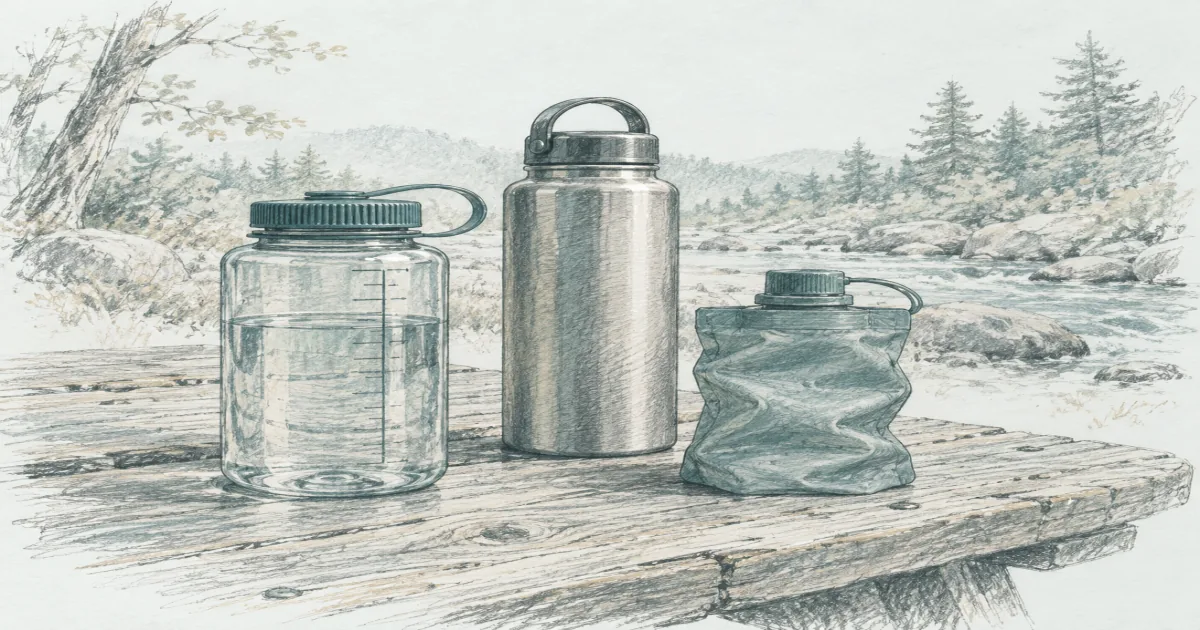
Trail water bottles come in three flavors. Hard plastic is tough and fills fast, but adds fixed bulk. Collapsible soft bottles pack flat and weigh almost nothing, but refill slower and feel weird in the hand. Insulated stainless keeps cold water cold on a hot day, but weighs more than plastic.
If you also need to treat water on the trail, the best camping water filter covers the matching filters. For storage at camp, the camping water jug holds extra filtered water for cooking and dishes.
What kind of water bottle you actually need
Backpacking water bottles split into three jobs. Hard plastic is the workhorse for weekend trips and groups. Collapsible soft bottles are the choice for thru-hikers and fastpackers who count cubic inches. Insulated stainless wins on summer desert trips and winter cold-soak mornings.
Match the bottle to the longest water carry on your route. A two-liter bottle plus a one-liter backup covers most three-season US trips. Larger bottles add weight and slosh around in side pockets on steep climbs.
The mouth size and threading matter more than people think. Wide mouths fill faster from shallow streams and accept ice cubes and backcountry filters. Standard 28 mm threads fit Sawyer, Platypus, and Katadyn filters without adapters. Narrow mouths drink cleaner but fill slower.
Nalgene 32 oz Wide Mouth for trail reliability
The Nalgene 32 oz Wide Mouth Water Bottle is the trail-tested default. Tritan plastic survives drops, wide mouths fill fast from streams and pots, and standard threads fit most backcountry filters. The bottle has been on the market for decades and every US outdoors store stocks it.
Best for weekend trips, group camping, and anyone who values reliability over weight. Skip it for thru-hikers counting ounces or anyone who wants cold water on a hot summer afternoon.
Tough plastic is the trade. The bottle does not collapse, so it always takes the same space in a side pocket. Use the volume markings on the side to mix drinks in the bottle at camp.
Who it is for: Weekend backpackers, group camps, and anyone who values reliability.
Who should skip it: Thru-hikers counting ounces and hot-desert trips where insulation matters.
Pros
- Tritan plastic survives drops
- Wide mouth fills fast from streams
- Standard threads fit most backcountry filters
- Volume markings on the side
Cons
- Fixed bulk in a side pocket
- No insulation
Shop: Nalgene 32 oz Wide Mouth on Amazon
Platypus Platy 2.0L when pack space rules
The Platypus Platy 2-Liter Ultralight Collapsible Backpacking Water Bottle is the choice when pack space rules. The bottle weighs about 1.3 ounces empty, collapses to almost nothing when empty, and stands upright when full. Standard threads accept Platypus caps, drink tubes, and most backcountry filters.
Best for thru-hikers, fastpackers, and trips where every cubic inch matters. Skip it for car camping where a hard bottle fills faster and lasts longer.
Soft bottles refill slower from shallow streams because the opening flexes under water pressure. Squeeze the bottle to push air out before submerging, then let it fill as you release. Pair the Platy with a Platypus QuickDraw filter for the cleanest setup.
Who it is for: Thru-hikers, fastpackers, and anyone watching pack volume.
Who should skip it: Car campers and trips with shallow stream refills.
Pros
- About 1.3 ounces empty
- Collapses flat when empty
- Standard threads fit Platypus filters
- Fits in a hip belt pocket when rolled
Cons
- Slower to refill from shallow water
- Less durable than a hard bottle
Shop: Platypus Platy 2.0L on Amazon
Hydro Flask 24 oz Lightweight Trail Series for cold water
The Hydro Flask 24 oz Lightweight Trail Series Wide Flex Cap is the insulated pick when cold water matters more than weight. The Trail Series stainless is about 25 percent lighter than the standard Hydro Flask 24 oz, the double-wall vacuum insulation keeps cold water cold through a hot afternoon, and the Flex cap is leakproof when closed.
Best for summer desert trips, hot southern routes, and winter cold-soak mornings where freezing water is a problem. Skip it for ultralight setups where the three ounces saved on a soft bottle beat the insulation.
Empty weight is the trade. The Hydro Flask weighs around 11 ounces empty, which is more than three times the Platypus. The wide mouth fills fast and the bottle threads onto most backcountry filters.
Who it is for: Hot weather trips, summer desert routes, and anyone who hates warm water.
Who should skip it: Ultralight setups where weight matters more than insulation.
Pros
- Cold water stays cold through the afternoon
- 25 percent lighter than the standard Hydro Flask 24 oz
- Flex cap is leakproof
- Wide mouth fills fast
Cons
- Around 11 ounces empty
- Less packable than a soft bottle
Shop: Hydro Flask 24 oz Lightweight Trail Series on Amazon
How to choose without overbuying
Pick one bottle that matches your trip, then add a backup. Two different bottle types on one trip usually means one stays in the pack and the other does the work. Choose two of the same pick if you can.
For most weekend US trips, the Nalgene 32 oz Wide Mouth is the right call. For thru-hikes and fastpacking, the Platypus 2L wins on pack volume. For summer desert trips, the Hydro Flask Trail Series is the only option that keeps water cold past lunch.
Mistakes that wreck backpacking water plans
Choosing a narrow-mouth bottle. Wide mouths fill faster, accept ice cubes, and accept backcountry filters. Narrow mouths drink cleaner but slow every refill. Most backpackers land on wide mouths.
Forgetting the threads. A bottle that does not thread onto your filter means extra adapters and slow refills. Most US backcountry filters use 28 mm threads. Check the bottle before you buy.
Skipping a backup bottle. A single bottle that leaks or falls in a stream ends the day. Always carry at least one backup bottle or a small soft flask as a redundancy.
Filling too early in the day. A full bottle sloshes and weighs more than you think. Fill at the last water source before camp, not at the trailhead.
Water treatment basics that pair with the bottle
A water bottle without treatment is half a system. Pair the bottle with a filter for clear streams, a purifier for sketchy sources, or both for travel. The Sawyer Squeeze threads onto the Nalgene and Platy and weighs about 3 ounces. The Platypus QuickDraw threads onto the Platy and the Hydro Flask Trail Series for the lightest setup.
For camp use, store treated water in a camping water jug at the picnic table. Use a camping water pump when the group needs to refill jugs fast from a shallow stream or lake.
For full boiling or sterilization rules, the how to boil water while camping guide covers when heat is part of the plan.
Bottom line
The best water bottle for backpacking matches the water risk and the pack fit for your trips. Pick the Nalgene 32 oz Wide Mouth for trail reliability and easy refills. Pick the Platypus Platy 2.0L when pack space and weight rule. Pick the Hydro Flask 24 oz Lightweight Trail Series when cold water matters more than ounces. Pair the bottle with a backcountry filter and a backup, and you stop worrying about water on the trail.
Frequently Asked Questions
What is the best water bottle for backpacking?
For most US trail miles, the Nalgene 32 oz Wide Mouth is the best water bottle for backpacking. It is tough, fills fast, and threads into common backcountry filters. Choose the Platypus Platy 2.0L when pack space rules, or the Hydro Flask 24 oz Lightweight Trail Series when you want cold water on hot days.
How big should a backpacking water bottle be?
Most people carry one 1 liter bottle for day hikes and one 2 liter bottle or reservoir for overnight trips. Match the bottle to the longest water carry on your route. Most US trail water sources are closer than people think.
Do backpacking water bottles need to filter?
The bottle is just a container. Pair it with a backcountry filter or purifier for untreated water. The Sawyer Squeeze and Platypus QuickDraw both thread onto standard 28 mm bottles and soft flasks.
Is a Nalgene or a Smartwater bottle better for backpacking?
A Nalgene is tougher and threads into filters. Smartwater is lighter and cheaper. Most weekend backpackers pick the Nalgene because the weight difference is small and the reliability is high. Thru-hikers who already own a Smartwater setup usually keep it.
Can you freeze a backpacking water bottle?
Plastic bottles freeze fine and double as ice packs in a bear canister. Stainless and aluminum bottles should not be filled to the top before freezing. Leave room for the ice to expand.
What about insulated water bottles for backpacking?
Insulated bottles keep cold water cold through a hot afternoon, which matters in the desert or summer. The trade is weight. A Hydro Flask 24 oz empty weighs about three times more than a Platypus 2L.
How do you clean a backpacking water bottle?
Wide-mouth hard bottles go in the dishwasher. Collapsible soft bottles need a bottle brush and a few drops of camp soap. Air dry fully before storage to stop mold on the inside.