Best Camping Saw (2026): Folding Saws for Firewood and Trail
Stoves
A folding saw turns deadfall and split logs into firewood without the noise or weight of a chainsaw. Match the blade length and teeth to the wood you cut.
Our picks
The best camping saw for most people is the Bahco Laplander Folding Saw, because it cuts firewood quickly for its size and folds small enough to keep in a day pack. A saw is the quiet workhorse of a campfire. It cuts deadfall into stove-length pieces without the swing a hatchet needs, and it is safer around kids and tired hands at the end of the day.
This guide covers folding saws for firewood, trail clearing, and car camp. It sits in the stoves and camp fire tools part of the site, next to the best camping stove. If you split wood rather than cut it, the best camping axe and the best camping hatchet are the chopping tools to compare. For ignition, see the camping fire starter.
What matters in a camping saw
Most folding saws look the same at a glance, so the blade is what separates them. Blade length sets the log size you can handle, and teeth per inch set the speed and the finish. The lock and the handle decide whether it is safe in a pack and comfortable in the hand.
A short blade is not a weakness. It is the reason the saw packs. If most of your wood is wrist-thick deadfall, a compact saw that lives in your pack beats a big one you leave in the garage.
Folding saw, bow saw, or hatchet
A folding saw is one piece that folds into its own handle. It is the easiest to carry and the safest to store. A bow saw has a wider frame and a longer blade, so it cuts bigger logs faster, but it does not fold and it takes more room.
A hatchet chops and splits where a saw cuts. For firewood, a saw does less work per piece and makes cleaner cuts on deadfall you should not chop. Many campers bring a compact saw for logs and a hatchet for splitting kindling, which covers both jobs without a chainsaw.
Comparison table
Top pick: Bahco Laplander Folding Saw
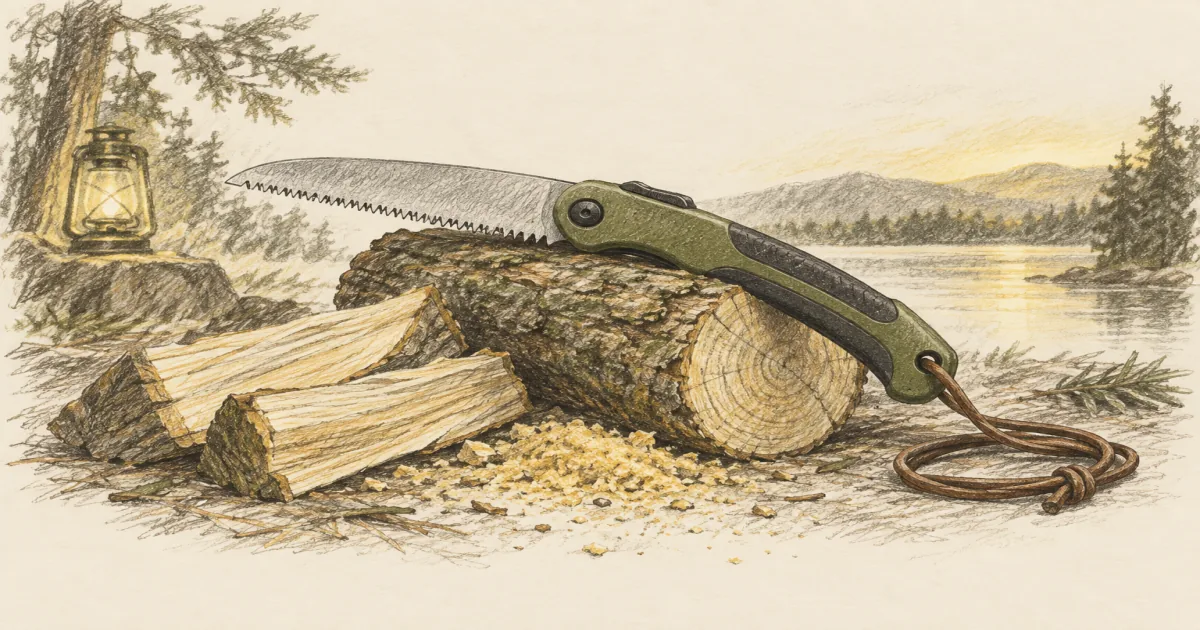
The Bahco Laplander Folding Saw is the best camping saw for most people because it does the whole job in about seven ounces. The 7-1/2 inch XT-tooth blade cuts on both the push and the pull stroke, which halves the effort on a thick branch. It handles small logs and branches up to about four inches across, which covers most campfire wood.
The safety details are why it stays in our pack. The blade locks open for cutting and closed for carrying, so it will not open inside a bag and bite your hand. The two-piece handle grips well when it is wet, and a leather thong keeps it from wandering off. Bahco sells replacement blades, so a dull edge is a swap, not a new saw.
The trade is reach. The short blade means you rotate thicker wood and cut from a couple of angles. If your firewood is routinely bigger than four inches, step up to the Gerber for the extra length.
Who it is for: Backpackers, car campers, and anyone who wants one compact saw for firewood.
Who should skip it: Campers who cut mostly big logs and want a longer blade.
Pros
- Cuts on both the push and pull stroke
- Locks open and closed
- Light enough for a day pack
- Replacement blades are easy to find
Cons
- The short blade tops out around four-inch logs
Shop: Bahco Laplander Folding Saw on Amazon
Best for bigger firewood: Gerber Freescape Camp Saw
The Gerber Freescape Camp Saw is the pick when you process real firewood at a drive-up site. Four pivot points spread a standard 12-inch blade across a wide cutting surface, so you can take on logs the compact saws cannot. It folds flat while staying assembled, which means no loose parts to drop in the dark.
The frame and grip are built for work. Bright accents make it easy to find when you set it down, and the rubber overmold handle grips in the rain. The blade is a standard 12-inch size, so you can replace it instead of buying a whole new saw. It weighs about 15 ounces, which is fine in a car kit and heavy for a long hike.
One habit keeps it cutting straight. The blade retention hook can spin and change the tension, so check it and snug it up before the first log. With a taut blade and full strokes, it makes quick work of a pile of camp wood.
Who it is for: Car campers, base-camp cooks, and anyone cutting bigger firewood.
Who should skip it: Backpackers who want the lightest saw in the pack.
Pros
- Folds flat with nothing to lose
- 12-inch blade for thicker logs
- Standard blade is replaceable
- Grippy rubber handle
Cons
- The tension hook needs a check before use
Shop: Gerber Freescape Camp Saw on Amazon
Cutting firewood without wrecking the blade
Let the saw do the work and keep the strokes long. Short, choppy strokes bind the blade and wear your arm out. On a thicker log, start a notch on one side, then rotate the wood and meet the cuts instead of forcing one deep pass.
Keep the blade out of the dirt. A few strokes in the soil at the base of a log will dull hardened teeth fast, and camp saw blades are hard to sharpen. Cut on a log or a stump, not on the ground, and brush the sap and grit off before you pack the saw away. A wipe and a drop of oil keeps a folding saw working for years.
Common mistakes
Pushing the saw into the cut. Let the teeth bite and use the full stroke. Bearing down bends the blade and wears you out.
Cutting on the ground. Dirt and small rocks dull the teeth in seconds. Brace the log on a stump or another log.
Skipping the lock check. A folding blade that opens in a pack is a cut waiting to happen. Confirm it locks closed before you pack it.
Choosing a saw that is too big. A bow saw cuts faster on big logs, but it does not fold. If you hike in, a compact folding saw wins.
Forcing a dull blade. Hardened camp teeth cannot be sharpened at home. Replace the blade or the saw once it stops biting.
Bottom line
The best camping saw is the one that folds small, locks closed, and still cuts a pile of firewood. The Bahco Laplander Folding Saw covers most campers with a light, packable blade that cuts both ways. The Gerber Freescape Camp Saw is the step up for bigger logs at a drive-up site. Pick the blade to match your wood, keep it out of the dirt, and your firewood will be ready before the coals are.
Frequently Asked Questions
What is the best saw for camping?
For most campers, the Bahco Laplander. It is light, it locks closed for safe packing, and its two-way teeth cut firewood quickly for a compact blade. If you cut bigger logs at a drive-up site, the Gerber Freescape and its 12-inch blade do more work.
What is a good small saw for camping?
Look for a folding saw under 10 inches closed with a locking blade. The Bahco Laplander folds to about nine inches and weighs about seven ounces, which is small enough for a day pack but still cuts four-inch branches.
What is the best saw for backpacking?
A short folding saw, not a bow saw. The Bahco Laplander is the usual pick because it is light and folds compact. Pair it with a fire starter and you can process deadfall without carrying a hatchet.
Saw or hatchet for campfire wood?
A saw cuts cleanly and quietly, and it works on deadfall you should not chop. A hatchet splits and limbers, and it needs a swing. Many campers carry both, a small saw for logs and a hatchet for kindling.
What is the best portable table saw for the money?
A table saw is a shop tool, not a camp saw. For camp, you want a folding hand saw you can carry to the fire ring. Keep the table saw at home and pack a folding saw for firewood.
How many teeth per inch should a camping saw have?
Around 7 teeth per inch is the all-purpose range for camp wood. Fewer teeth cut faster but rougher, and more teeth leave a cleaner edge but cut slower. For firewood, the middle range works on green and dry wood.
Can you sharpen a folding saw blade?
Usually no, not at home. Hardened camp saw teeth are hard to sharpen without special files, so most people replace the blade when it dulls. Keep the blade off rocks and metal and it stays sharp for a long time.