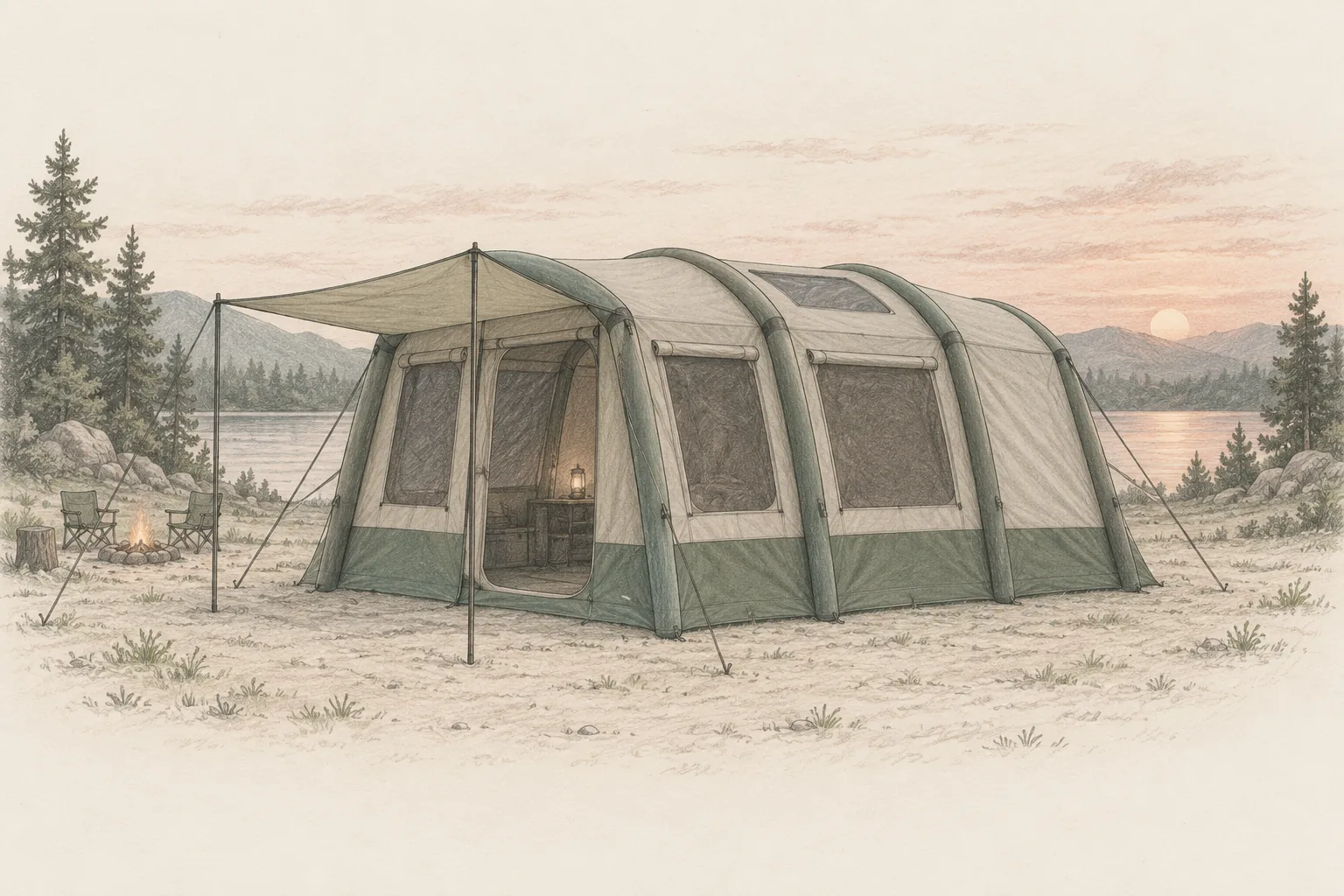
Best Inflatable Tent for Camping (2026): Air Beam Picks That Stand
Tents
The best inflatable tent for camping trades poles for air beams and pitches in minutes. Here are a 4-season family tent, a fast auto-inflating budget model, and a stove-jack hot tent, with the setup and care each one needs.
Our picks
The best inflatable tent for camping is the one that stands up fast and stays up. Air beams replace the pole puzzle, so a big tent that used to take twenty minutes goes up in two or three. The catch is weight and packed size, which is why these tents live in the car, not on your back.
If you split your camping between drive-up sites and the trail, start with the tents category. Our lightweight backpacking tent guide covers the carry-it-far end of the shelf, and this page covers the stand-up-and-relax end.
The other thing to know up front: any air tent needs care. Stake it, guy it, and protect the beams from sharp ground, and it will last years. Skip those steps and a slow leak will find you at 2am.
What an inflatable tent does better than a pole tent
Air beams are the whole idea. Instead of threading poles through sleeves, you connect a pump, and the frame rises as one unit. A large family tent that takes two people and twenty minutes with poles becomes a one-person job in a couple of minutes.
The beams are also forgiving. They flex in wind instead of snapping, and there are no pole ends to lose. On a dark arrival, that matters more than the spec sheet suggests.
The tradeoffs are real. Air tents are heavier and bulkier than pole tents, and they cost more for the same space. They also want a flat, cleared patch of ground so nothing sharp sits under a beam. Pick one for the site, not for the trail.
Top pick: Homevol 4-Season Blow Up Tent
The Homevol 4-Season Inflatable Tent is the best inflatable tent for camping when you want space, weather protection, and cold-night capability. It sleeps four to six and measures about 118 by 83 by 79 inches.
The 5-inch PVC beams use a three-layer build with an abrasion-resistant outer layer, so they stand firm without the bounce you get from a thin air mattress. The 600D Oxford shell is rated to 5000mm, and the included stove jack turns it into a shoulder-season shelter. Anchor points and a rated wind structure keep it steady when you stake it out properly.
Who it is for: Families and groups who camp from the car or truck and want a fast, roomy base.
Who should skip it: Backpackers, and anyone who camps alone with minimal gear.
Best budget: Fseoot Quick Automatic Inflatable Tent
The Fseoot Quick Automatic Inflatable Tent is the best inflatable tent for camping if you want the easiest pitch and a lower price. It measures about 83 by 83 by 69 inches and weighs roughly 14 pounds.
The auto-inflate pump is the headline feature. It fills the frame, then stops itself before over-inflation, so you are not standing over it guessing. Two doors, large mesh windows, and roof vents move air through on a warm night, and the 210D silver-coated shell handles light rain with a 3000mm rating.
Who it is for: First-time air-tent buyers, solo campers, and anyone who wants a simple weekend shelter.
Who should skip it: Cold-weather campers and anyone expecting heavy-storm performance.
Best hot tent: WildFinder Inflatable Tent with Skylight
The WildFinder Inflatable Tent is the best inflatable tent for camping when cold nights are part of the plan. It sleeps four to six, stands about 79 inches tall, and runs on replaceable TPU air beams wrapped in protective covers.
The built-in stove jack is what separates it from a summer air tent. Add a small wood stove and the same shelter works well into fall and winter. The panoramic skylight, the zip-on awning, and the 420D shell with a 3000mm rating round out a tent that feels more like a cabin than a dome.
Who it is for: Cold-weather campers, glamping setups, and families who want a stove-capable base.
Who should skip it: Anyone packing it into a backcountry site, or camping in deep summer heat.
Inflatable tent comparison
Pick the Homevol for the best all-round shell, the Fseoot for the easiest setup and lowest price, and the WildFinder when a wood stove is part of the trip.
Setup and care for air beams
Clear the ground first. A sharp rock or a pine cone under a beam is how leaks start. Rake the site or lay a tarp before the tent goes down.
Stake before you pump. Lay the tent out, stake the corners, then inflate. The frame rises into shape instead of dragging across the ground.
Do not over-inflate in the heat. Air expands as the day warms. Use the recommended pressure, and let the over-pressure valve or a quick release handle the rest.
Watch the valves. A valve that is not fully seated is the most common slow leak. Check them before you blame the beam.
Dry it before storage. Fold and dry the tent at home. Trapped moisture is what turns a good air tent musty and shortens the beam life.
Who should skip an inflatable tent
If you backpack, skip it. Every pick here weighs more than a pole tent of the same size, and the packed bundle is bulky. A lightweight backpacking shelter is the right tool for miles.
If you camp in extreme wind or heavy snow, think twice. Air tents can handle a lot when they are staked and guyed, but a four-season mountaineering tent is built for that abuse. Air tents shine at the drive-up site where comfort and setup speed matter more than ounces.
If storage space is tight, measure the packed bag first. A big air tent folds into a sizeable bundle, and it does not compress the way a pole tent does.
Bottom line
The best inflatable tent for camping is the one that matches your site, your season, and how much you want to carry. Buy the Homevol 4-Season for a roomy, weather-ready family base. Buy the Fseoot Quick Automatic for the easiest pitch at the lowest price. Buy the WildFinder Skylight when you want a stove jack and a tent that works into winter. Set it up once at home so the first real trip is not the trial run.
Frequently Asked Questions
Are inflatable tents any good for camping?
Yes, for car camping and family sites. The beams are thick and hold air for weeks, and setup is faster than a pole tent. The trade is weight and packed size. For backpacking, a lightweight pole tent is still the better choice.
What are the disadvantages of inflatable tents?
They are heavier and bulkier than pole tents, and they cost more for the same floor space. Single-skin air tents also collect condensation, so you have to vent them. A puncture is possible, though most beams patch or replace easily.
How long will an inflatable tent stay inflated?
A good one holds pressure for weeks, not hours. Owners report trips of several days with no top-off. If it sags overnight, check the valves first, then look for a slow leak with soapy water.
Do inflatable tents leak?
Air leaks are the most common air tent problem, usually from a puncture or a valve. The fix is a patch kit or a replacement beam, both of which most tents include or sell. Staking the tent properly and clearing sharp ground under it prevents most punctures.
Can you use an inflatable tent in winter?
Yes if it has a stove jack or a solid four-season shell. The WildFinder and Homevol picks both take a wood stove, which is what makes a winter camp comfortable. Without a stove, a big air tent gets cold fast.
How do you patch an air beam?
Deflate the beam, clean the area, and apply the patch from the kit. Soapy water shows you the hole first, since bubbles form at the leak. Some tents use zippered covers so you can swap a whole beam instead.
Are inflatable tents good in wind?
They do well when they are staked and guyed out properly. The beams flex instead of snapping, which helps in gusts. The Homevol shell is rated for winds up to about 50 mph when it is secured correctly.
Do you need electricity to inflate an air tent?
No. The included pumps are manual or foot pumps, so you inflate by hand in a few minutes. The Fseoot model has its own battery-powered pump with an auto shut-off, and it recharges on USB.