Best Backpacking Coffee Maker (2026): Packable Brews Under a Pound
Coffee
The best backpacking coffee maker stays under a pound, survives a stuff sack, and still makes a clean cup. Press kits win most miles; pump espresso and plastic drippers cover narrower jobs.
Our picks
The best backpacking coffee maker is the one that still fits after you pack food, shelter, and a stove. That usually means a nested press mug, a small pump espresso, or a plastic dripper that weighs less than a snack bar. Car-camp French presses and big percolators belong on another page.
If you cook at a picnic table more than you hike, start with our best camping coffee maker guide instead. This article is for packed weight and stuff-sack reality. Browse the coffee category for brew style deep dives, and see camping AeroPress for Go kit setup detail.
What separates a backpacking coffee maker from a camp one?
Weight and packed shape separate them. A backpacking maker has to survive a stuff sack and stay near a pound, while a camp maker can be a two-and-a-half pound insulated press because it rides in a car.
The second difference is volume. Trail gear brews one cup at a time, because a second cup means a second boil and more fuel. Camp gear brews a pot. If you hike with a partner and both want coffee, either accept two presses or carry a bigger maker and more water.
The third is cleanup water. On the trail, rinse water is drinking water. A maker with many small parts costs you ounces you filtered, so the best trail rig is usually the one with the fewest pieces and the fastest rinse.
Which brew style fits your pack weight?
Press, pump, or pour-over is the real choice, and each one wins a different trip. Pick by how much you care about taste, how much you care about ounces, and how much cleanup water you are willing to spend.
All three need hot water from your stove. None of them replace a kettle or pot. Pair with a camping kettle if pour control matters.
Our picks
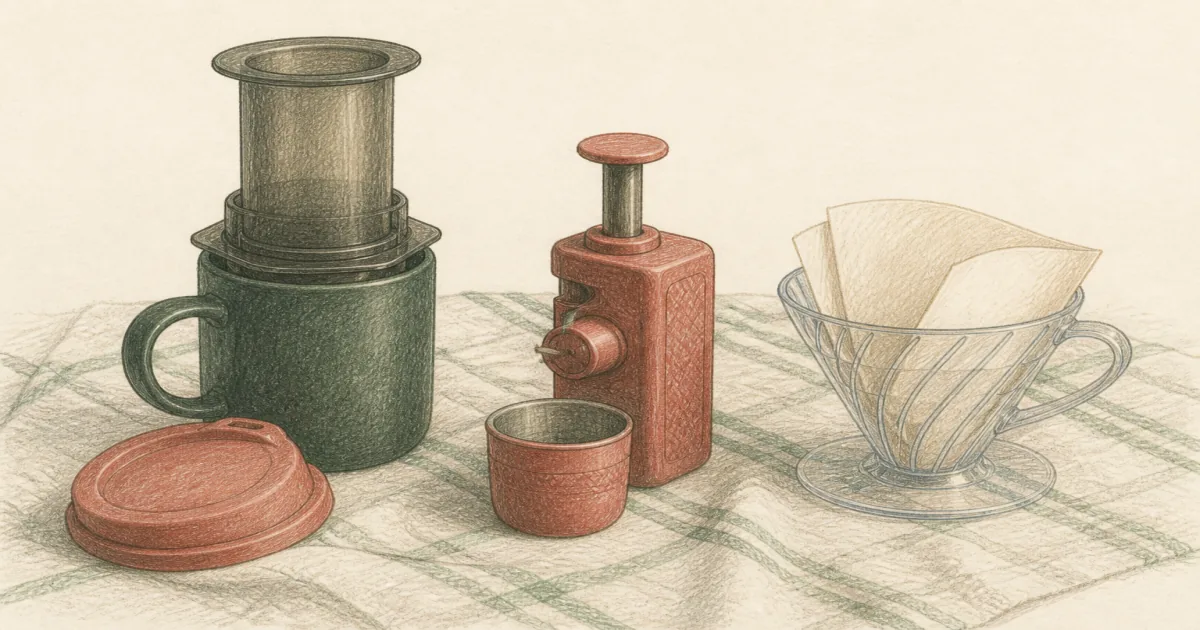
Three makers cover the three real trail jobs. One nests into its own mug, one pulls a pressurized shot, and one is barely there in the pack.
AeroPress Go Extra Small Portable Coffee Maker Kit
The AeroPress Go Extra Small Portable Coffee Maker Kit is the best backpacking coffee maker for most hikers because it is a complete system in one object. The chamber and plunger fit inside the travel filter holder at 11.4 oz (323 g), the mug doubles as the case, and the whole kit packs about the size of a large camping mug.
It brews 8 ounces per press, a little less than the AeroPress Original's 10 ounces, and the mug holds 15 ounces, which covers a second small cup. The paper microfilter leaves very little sediment, so the cup stays clean without a second rinse.
Two details from long-term users are worth knowing. The mug does not lock hard onto the chamber, and owners find that a non-issue in practice, stable even in wind. And bikepackers often swap the plastic cup for their own titanium mug because the square plastic cup is not pleasant to drink from. Bring the mug you like if you already have one.
Best for solo and duo trips and anyone who already likes AeroPress at home. Skip it if you need four cups at once or refuse to pack paper filters.
WACACO Nanopresso Portable Espresso Maker
The WACACO Nanopresso Portable Espresso Maker is the pick for pressure. It weighs 336 g (11.9 oz), holds 80 ml of water, and takes an 8 g basket that can grow to 16 g with the Barista kit. The patented pump reaches up to 18 bar (261 psi), which is more than most countertop machines deliver.
That pressure costs effort. Pumping at full pressure takes about 13 kg (28.7 lb) of hand force, and Wacaco recommends holding the body with both hands. Tom's Guide found that an 8 g dose could not build enough resistance and produced watery shots, and that a 16 g basket or an 18 g dose fixed it. The grind wants to be extra fine, finer than pour-over and closer to espresso.
Real-world reports are encouraging. Epicurious brewed a shot with kettle water, no thermometer, no scale, and still got "a lovely layer of crema." The parts count is the trade: basket, seals, cup, and pump all need a rinse, which is more cleanup water than the AeroPress.
Best for espresso-first hikers who accept more parts and a longer morning. Skip it for ultralight base weights or for groups that need a full mug each in one brew.
Sea to Summit Frontier UL Collapsible Pour Over
The Sea to Summit Frontier UL wins when every gram fights for a slot and you already boil water in a pot. It folds to about 0.7 inches flat, covers 1 to 2 cups, and weighs about 2 oz (57 g). The silicone body survives pack lids better than glass, and the integrated stainless mesh means you never pack paper filters again.
The mesh is the point. Fine grounds can pass if you pour too fast, so a medium grind and a patient bloom keep the cup clean. Cleanup is a quick rinse under a stream, which saves the filtered water the paper-filter path would spend.
Best for pour-over fans and long-mile hikers. Skip it if your pour is shaky on uneven ground or you want the crystal-clear clarity a paper filter gives.
How much does a trail coffee kit weigh?
The maker is the small part. A hand grinder, beans, filters, and the water you boil usually weigh more than the brewer, which is why a light maker can still produce a heavy kit.
Gear weight versus water weight
Start with the brewer. The Frontier UL is about 2 oz, the AeroPress Go is 11.4 oz, and the Nanopresso is 11.9 oz. Then add the rest: a hand grinder runs about 1 lb, a 12-ounce bag of beans is 12 oz, and a mesh filter pack is nothing because the filter is built in.
That math is why the AeroPress Go review on Trailspace put a grinder, beans, and the Go into a stuff sack that weighed 2.0 lb, and the hiker sent it home before a long climb. If you pre-grind at home, you delete the grinder and the kit drops under a pound. The honest answer is that fresh-ground trail coffee costs about a pound of pack weight, and that trade is yours to make.
Dial in the grind before you leave
Every one of these makers is grind sensitive, and camp is the wrong place to discover it. Grind medium-fine for the AeroPress and the Frontier UL, and extra fine for the Nanopresso. If the Nanopresso is hard to pump, the grind is too fine and the basket is clogging, which is the signal to back it off.
Pre-grind at home into a sealed bag if you are skipping the grinder, and portion it per morning. Guessing with a dirty spoon at camp wastes fuel and coffee. A 12-ounce bag of grounds is about 42 Nanopresso shots at 8 grams each, which is more than a week of mornings.
Brew steps that survive a cold morning
Heat only the water you need. Extra boiling wastes fuel and time when you still have miles left, and if you share a stove, boil once for coffee and breakfast bags instead of lighting it twice.
On cold mornings, preheat the chamber with a splash of hot water, dump it, then brew. Plastic and metal gear steals heat on the first pour, which is how a cup that started with boiling water ends up lukewarm. The Nanopresso has the same fix: run one cycle of hot water through it before the real shot.
Keep filters and grounds in a dry bag. Wet paper filters turn into pulp, and coffee dust in the food bag flavors everything else. On the AeroPress, use medium-fine grounds, hot water just off the boil, a short steep, and a steady press, then rinse the chamber before packing so oils do not go rancid in the stuff sack.
Mistakes that waste pack weight
Buying a glass press for backpacking. Glass is for the picnic table. Use plastic, metal, or a nested kit on trail.
Packing a maker without a brew plan. Pre-measure grounds per morning and bring the filter count you need, not the whole box.
Cleaning with the last of your drinking water. Filter or treat first, then rinse gear, and let coffee oils wait for a larger water stop if you are dry.
Carrying a mug you do not like. If the nested cup is the weak point, bring your own and leave theirs at home, which costs nothing extra.
Forgetting the water weight. A liter of water is about 2.2 lb, so the pot you boil in matters as much as the maker that brews in it.
Bottom line
The best backpacking coffee maker for most hikers is the AeroPress Go, because it packs into its own mug at 11.4 oz and cleans up in about twenty seconds. Take the WACACO Nanopresso when you want real crema and will accept more parts and a firmer pump, and the Sea to Summit Frontier UL when ounces matter most and you already carry a kettle. Whichever you choose, dial the grind at home, boil only the water you need, and keep the kit under a pound by leaving the grinder behind.
Frequently Asked Questions
What is the best backpacking coffee maker overall?
For most hikers, the AeroPress Go Extra Small Portable Coffee Maker Kit is the best backpacking coffee maker. Choose the WACACO Nanopresso for espresso pressure, or the Sea to Summit Frontier UL when you want ultralight pour-over.
Is a backpacking coffee maker different from a camping coffee maker?
Yes. Backpacking gear prioritizes packed size and weight. Car-camp makers can be heavier insulated presses and percolators. For picnic-table group brews, see our best camping coffee maker guide.
Do I need a special stove for backpacking coffee?
You need hot water, not a coffee-only burner. Any stable canister stove works. Heat water in a pot or kettle, then brew off the flame.
French press or AeroPress on the trail?
AeroPress packs smaller and usually tastes cleaner with paper filters. A metal press can work if you already own one and accept grit and extra weight.
How fine should I grind for backpacking coffee?
Medium-fine for AeroPress and pour-over cones. Espresso pumps want finer grounds and a firm tamp. Pre-grind at home into a sealed bag if you skip a trail grinder.
Can I brew without paper filters?
Nanopresso uses a metal basket. AeroPress accepts metal disks, though taste changes. The Sea to Summit Frontier UL has a built-in stainless mesh, so it never needs paper.
What about instant coffee for backpacking?
Instant wins on weight and cleanup. Bring a real maker when taste matters more than the last ounce. Many hikers pack both for long trips.
How much does a backpacking coffee kit weigh?
The AeroPress Go packs at 11.4 ounces, the Nanopresso at 11.9 ounces, and the Sea to Summit Frontier UL at about 2 ounces. Add a hand grinder and beans and the kit crosses two pounds.