Solar Camping String Lights (2026): Hang-and-Go Glow for Tables and Awnings
Lighting
Solar camping string lights cut out disposable batteries and campfire glare. Match the panel to your campsite sun, pick a length that fits your table, and keep USB charging as a rainy-weekend backup.
Our picks
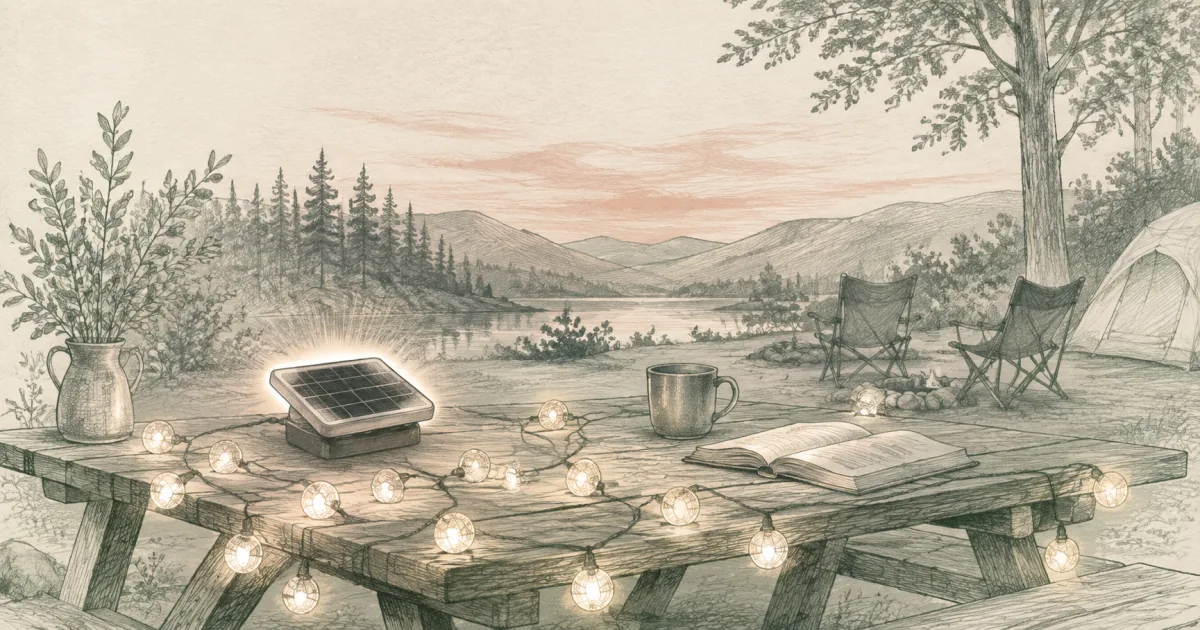
A lantern blasts light straight down on dinner. Solar camping string lights spread soft glow across the table and awning so faces look normal and cards read fine. They collapse into a 2-inch puck the next morning. The panel refills the battery through the day, and a USB cable tops it up when the sky stays gray.
For the full best-of across solar, AA, and USB power, our best camping string lights guide covers the wider set; this page owns the solar-only lane. See the full lighting buying guides for lanterns, headlamps, and string lights by use case.
When solar actually pays off at camp
Solar pays off when the panel sits in real daylight for several hours. Weekend car camp with open sky is the easy case. You pack the car, the string light parks on a picnic table in the sun, dinner light is ready when you get back.
Solar struggles under heavy tree cover, in deep winter short days, and when the panel is buried under a stuff sack all afternoon. If your trips are rainy forests or short winter weekends, treat the panel as a daily top-up and lean on USB from a power bank or car charger. That hybrid habit is why the picks below all accept USB as a backup charge port.
Skip solar-only thinking for expedition nights with no sun and no backup. Bring a second light. A headlamp for camping covers hands-free chores when the string sits on the table.
Length, panel size, and what you actually see
Length is the easiest decision. Measure the table or the awning run you want to light before you order. Eighteen feet covers a small picnic table and a short awning. Thirty-two to forty-four feet handles a long trailer awning or a group site. Strings you can extend with a second strand give you the most flexibility.
Panel size is not the bottleneck. Built-in panels on camping string lights are small by design, often 1 to 3 watts, and that is plenty for the battery inside. The constraint is sun hours, not watts, so park the hub where it gets midday light and leave it there.
Brightness matters less than even light and a low mode you will actually use. One hundred lumens across an 18 ft strand reads soft and even at dinner. Cold blue-white LEDs feel like a parking lot at the camp table. Warm white reads closer to firelight.
Solar vs AA vs USB for string lights at camp
Solar wins when you remember to park the hub in sun and you do not want to carry spare cells. AA strands win when you want no cable and zero solar discipline. USB-rechargeable strands win when you already pack a power bank for phone and lantern.
If you camp a mix of sunny weekends and rainy ones, solar+USB is the honest middle. The picks below all accept USB so a power bank or car charger covers the cloudy week. Pure AA strands work fine for one weekend, then you are digging for cells at dusk on trip two.
Top pick: MPOWERD Luci Solar String Lights 18' Warm White
The MPOWERD Luci Solar String Lights 18' Warm White is the one to beat for most car camps. The hub is the solar panel, the battery, and the storage case all in a 2-inch puck that weighs 11 ounces. Unspool the 18 ft cord with 20 warm white LEDs along an awning or table, then clip the hub where it sees a little sun the next day. USB-A tops it up under gray skies or heavy cover.
This set also charges a phone over USB when you need a quick boost. The cord is nylon-braided and the bulbs are shatterproof, which matters when you coil the strand back into the puck after dinner.
Who should pick it: Car campers who want one string light that charges itself, packs flat, and doubles as a phone charger on long weekends.
Who should skip it: Campers with a long trailer awning who need 30 to 44 ft of cord, or anyone camping mostly under tree cover who cannot keep a panel in real sun.
Best lantern + string combo: TuoPuLife 32.8 FT 4-in-1
The TuoPuLife 32.8 FT 4-in-1 is the right pick when you want a lantern hub and a long string in one unit. The retractable design pulls the 32.8 ft strand of 130 warm white LEDs back into a small lantern you can set on the picnic table. Eight lighting modes and three brightness levels cover everything from a steady dinner glow to an SOS flash.
It charges from a built-in panel over 8 hours of sun, or from USB-C in about 4 hours. The 1800 mAh battery runs up to 8 hours on full brightness and 18 hours on the lowest setting. The whole unit collapses for storage.
Who should pick it: Campers who want a longer string and a tabletop lantern in one piece, plus SOS and flash modes for emergencies.
Who should skip it: Buyers who want a detachable cord or a much longer runtime on high mode. The 4-in-1 trades runtime for length.
Best color: MPOWERD Luci Color Solar String Lights 18'
The MPOWERD Luci Color Solar String Lights 18' is the same Luci hub design with 7 color modes and a smooth color-cycle setting. The strand still has 100 lumens across 18 ft and 20 LEDs, still charges from solar or USB-A, and still tops up a phone when you need it.
Color modes are fun for tent evenings, group sites, and poolside weekends. Runtime drops to about 15 hours because the color cycling draws more power than steady warm white. Treat the color set as the mood light and the warm white set as the everyday light.
Who should pick it: Campers who want color cycling for tent evenings or awning mood, with the same pack-flat solar hub as the warm white Luci.
Who should skip it: Readers who want only steady warm white. The warm white version has a stronger review base and longer runtime per charge.
How to hang and care for solar string lights at camp
Hang the strand above head height so people walk under it without touching bulbs. Two-inch zip ties on awning poles work fine. Hook clips, like the ones on the Luci strand, clip to a paracord ridgeline or a tarp tie-out.
Keep the solar panel flat and in direct midday sun while you cook, hike, or drive. Wipe dust and pine pitch off the panel before charging. A dirty panel is a weak charger even under a clear sky.
Dry the hub and ports if rain pools on the storage case. Open any charge port cover carefully so grit does not chew the threads. Store the strand coiled back in the puck between trips so the cord does not kink.
Charge before you leave home if the forecast is gray. Top up from a power bank at the trailhead if you forgot. A small power bank dedicated to lights is often smarter than draining the string hub into a phone.
Common mistakes with solar camping string lights
Treating solar as a one-and-done charge. It is not. Cloudy days and shaded panels mean a partial refill, not a full one. Plan to top up from USB on any weekend where the sky is forecast to stay gray.
Hanging the strand too low. Bulbs at face height feel brighter than you expect. Above head height reads softer and keeps the cord clear of heads, packs, and pets.
Forgetting to wipe the panel. Pitch, dust, and bug splatter cut output. A soft cloth once a day is enough.
Draining the hub into a phone on night one. You start night two dim and annoyed. Use low or medium by default and save the phone boost for emergencies.
Leaving the cord pinched in a zipper or awning track. Pinched wires are the fastest way to kill a strand. Check the run before you close up.
How solar string lights fit the lighting kit
A solar string light handles the table and the awning. A lantern covers a single spot or a moving chore. A headlamp handles dishes and tent zippers. You do not need every category on every trip. Start with one solid lantern and add a solar string light if the site feels cave-dark.
For broader battery and USB options, our best camping lantern guide covers the cross-power comparison. For solar-only lanterns, the solar camping lantern page is the sibling pick. Rechargeable table lanterns sit in best rechargeable camping lantern. Tent-side ideas live in tent lighting ideas.
Bottom line
A solar camping string light is the easy glow that runs itself on sunny weekends and tops up from USB when the sky stays gray. Pick the length that fits your table, keep the panel in midday sun, and bring USB as a backup. Steady warm light beats a dead spotlight every time.
Frequently Asked Questions
How long do solar camping string lights take to charge?
Most built-in panels need a full day of real sun to refill from empty, and many report 14 to 16 hours of direct light. Top up from USB the night before if the weekend forecast is gray or you are camping under heavy tree cover. Treat solar as a daily top-up, not a one-charge-per-trip system.
Do solar string lights work on cloudy days?
They charge, but slowly. Cloud cover cuts panel output by half or more. Pick a set with USB or USB-C input so you can refill from a power bank when the sky stays gray. The Luci and TuoPuLife picks below both accept USB when the panel cannot keep up.
Are solar camping string lights bright enough to read by?
No. Most sit in the 100 to 200 lumen range and spread soft ambient light across the table and awning. They are not task lights. Pair them with a headlamp for camping or a small lantern for cooking, dishes, and reading. Save string lights for dinner, cards, and the walk to the bathhouse.
Can solar string lights stay outside in rain?
Most camping string lights carry an IP44 splash rating, which covers light rain and a brief shower. They are not designed for submersion or extended downpours. Dry the panel and ports if rain pools on the hub, and bring the unit inside during a storm so the battery and USB port stay healthy.
How long do the bulbs last on a full charge?
Runtime depends on mode. Luci reports up to 20 hours on low for the warm white set and up to 15 hours for the color set. TuoPuLife's 4-in-1 lists up to 8 hours on full brightness and 18 hours on the lowest mode. Plan dinners on low or medium and save high for short bursts.
Can I hang solar string lights inside a tent?
Yes, as long as the LEDs run cool and the cord stays clear of zippers and exits. LED strings do not get hot like filament bulbs, but pinching a wire in a zipper is the fastest way to kill a strand. Pick low-output warm modes so the light does not blast at pillow height.
Do solar string lights attract bugs?
Warm, lower-output LEDs pull fewer insects than cool blue floods. Bugs react more to brightness and color temperature than to power source. If bugs are a real problem, switch to the lowest warm mode and keep food sealed and trash closed.
What size solar panel do I need to keep string lights running?
Built-in panels on camping string lights are small by design, often 1 to 3 watts, and that is fine for the battery inside. You do not need an extra panel. The bottleneck is sun hours, not panel size, so park the hub where it gets direct midday light and top up from USB the rest of the time.